Draft 1
In John Yuyi’s Skin on Skin, nude self-portraits become temporary tattoos on pork skin. She describes the work’s “cyclical nature” (Weinstock, 2018): skin becomes an image placed on another skin. Her question, “Why don’t I put my skin on animal’s skin?” (Weinstock, 2016), sits alongside her later question about what distinguishes human and pig skin through texture alone (Wazaiii, 2018).
Preparing the copy has involved adjusting the image size to fit the meat. This raises a question about the transfer itself: what does it preserve of the person pictured, and what does the new surface change? When does a body remain recognizable as someone’s own, and when does it become a collection of parts to be judged? Does placing the image on meat encourage that judgment, or expose expectations we already bring to images of women’s bodies? Can choosing how a body appears offer control without repeating those expectations?
Using photographs of my own body would let me examine these questions as both subject and viewer. One possibility is to transfer separate body parts onto pork skin, repeatedly changing their order, spacing, and orientation to see when I recognize myself and when the parts seem interchangeable. Alternatively, I could place the same images on pork and my own skin, varying their size and position across both surfaces to explore what makes them feel like mine. A third possibility is to keep an image unchanged while altering its wrapping, label, and price, testing how readily I assess my body as a product. In whichever direction I pursue, photographs and written observations would record these shifts, including responses I had not anticipated.
References
Wazaiii (2018) ‘Wazaiii Give Me 5─John Yuyi五件藝術大作和她如謎一般的創作之旅’, 16 December. Available at: https://www.wazaiii.com/articles?id=interview-John-Yuyi (Accessed: 11 October 2026).
Weinstock, T. (2016) ‘Yuyi John is the Willy Wonka of the art world’, i-D, 11 August. Available at: https://i-d.co/article/yuyi-john-is-the-willy-wonka-of-the-art-world/ (Accessed: 11 October 2026).
Weinstock, T. (2018) ‘The Instagram artist turning her social media addiction into art’, i-D, 21 February. Available at: https://i-d.co/article/the-instagram-artist-turning-her-social-media-addiction-into-art/ (Accessed: 11 October 2026).
Draft 2
Skin on Skin (2016) asks what happens to the image of the body when it is transferred onto animal skin. In my iterations, I transfer photographs of my own body onto pieces of meat; my question is whether the person remains in that image, or whether the body is reduced to separate parts.
Eva Stenram’s Drape gives me a way to examine what it means to read a body as parts. Stenram scans vintage pin-up photographs of women and digitally extends the curtains behind them to partly conceal their bodies. She writes: “Once the backdrop falls in front of the model, showing just parts of her body, our voyeuristic desire becomes clearer” (Stenram, n.d.). In her account, concealment does not hide the body so much as expose the viewer’s desire to look at it. For my project, this raises a distinction between physically separating my image and directing attention toward separate parts of my body. The cuts will divide the image, but they cannot determine how someone looks at it.
Where Stenram interrupts the visibility of an existing figure, I am trying to restore a figure after separating its image. I will reconstruct the photographed image of my body on pieces of meat, keeping the pose as close to the original as I can. Yet a recognizable outline would not settle the matter. Someone could follow the pose across the pieces while still reading an arm or a leg as an isolated object; the meat underneath gives each transferred section a separate physical boundary.
Stenram’s exchange of foreground and background also makes me reconsider the surface carrying my image. Her curtains move forward and interfere with the figure. In my work, the meat cannot be treated as a neutral background either; its texture, edges, and associations could compete with the photographed body for attention. Rebuilding the pose faithfully will not remove those differences: the seams may hold the figure together visually while keeping the separate pieces apparent.
Unlike the found photographs in Drape, my images begin with choices I make about my own body: how to pose and where to divide the image. That gives me control over making the representation, but not over how it is received. Even a pose I choose could become a way of displaying individual body parts once transferred and divided.
Drape helps me distinguish the physical fragmentation of my image from the possible reading of my body as an object. In the reconstructions themselves, I want to look beyond whether each pose matches: whether the separate surfaces encourage attention to move across my body or settle on particular parts, and what becomes of my self-image in that shift.
Stenram, E. (n.d.) Drape. Available at: https://www.evastenram.net/drape (Accessed: 20 October 2026).
Draft 3
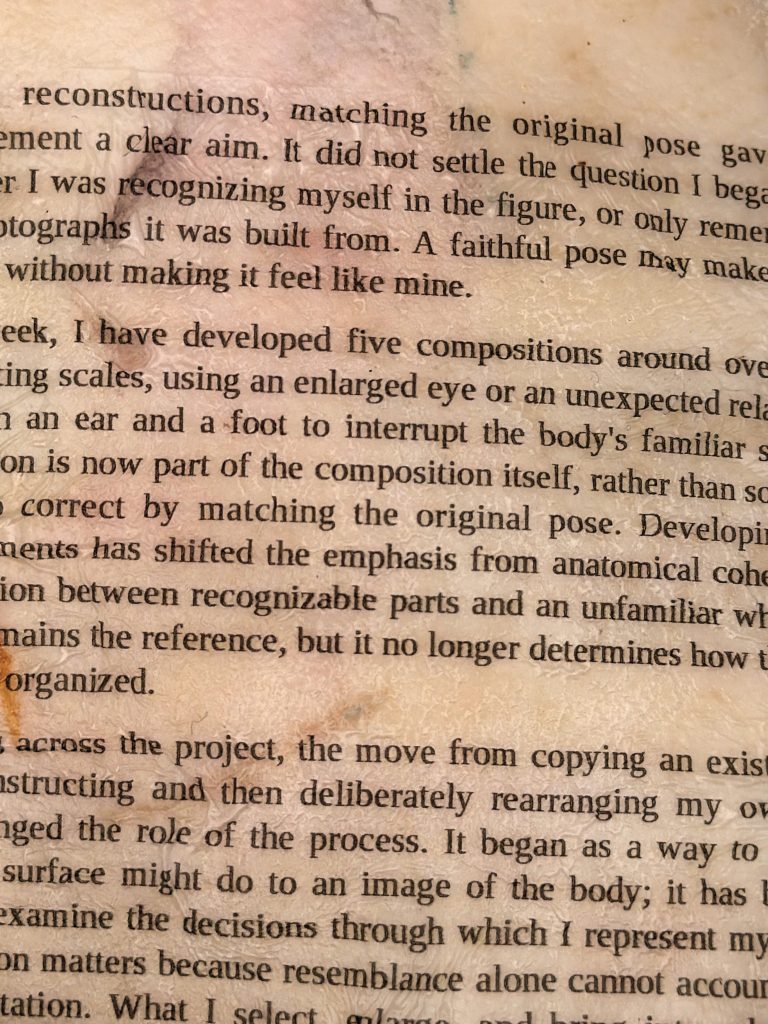
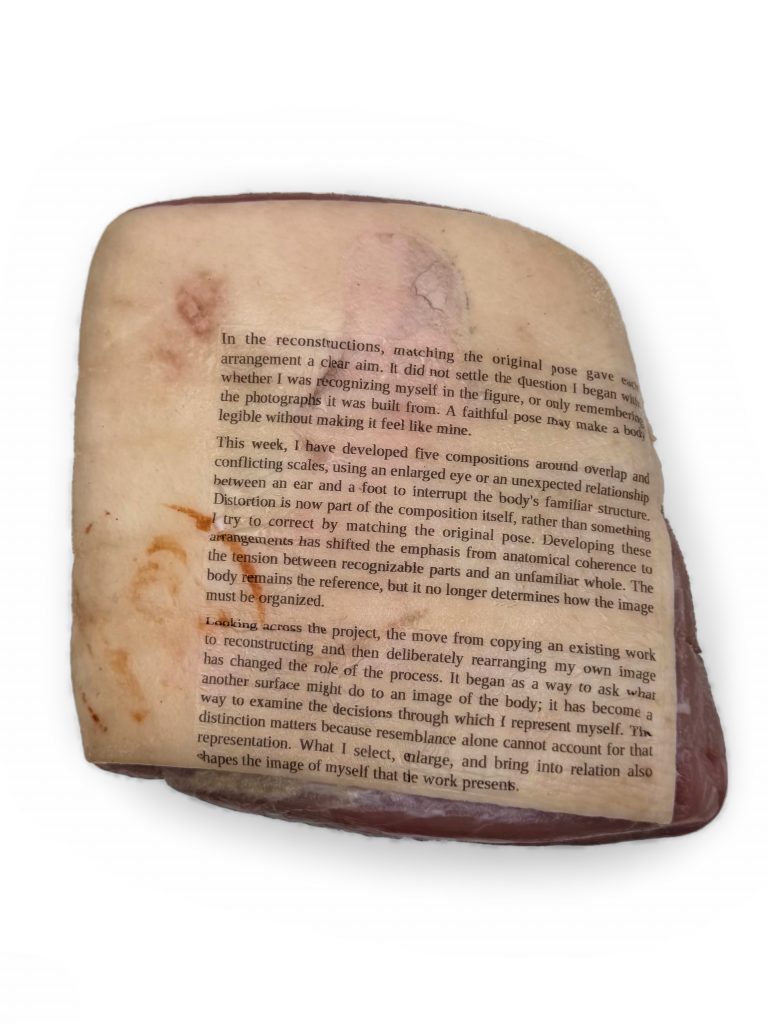
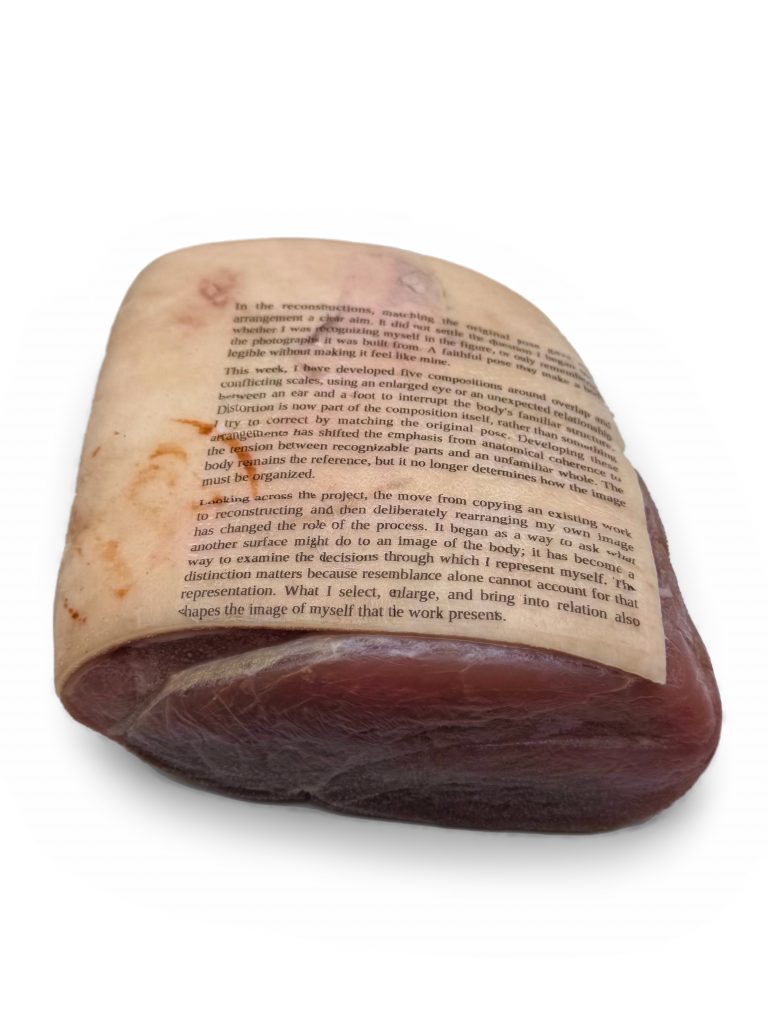
In the reconstructions, matching the original pose gave each arrangement a clear aim. It did not settle the question I began with: whether I was recognizing myself in the figure, or only remembering the photographs it was built from. A faithful pose may make a body legible without making it feel like mine.
This week, I have developed five compositions around overlap and conflicting scales, using an enlarged eye or an unexpected relationship between an ear and a foot to interrupt the body’s familiar structure. Distortion is now part of the composition itself, rather than something I try to correct by matching the original pose. Developing these arrangements has shifted the emphasis from anatomical coherence to the tension between recognizable parts and an unfamiliar whole. The body remains the reference, but it no longer determines how the image must be organized.
Looking across the project, the move from copying an existing work to reconstructing and then deliberately rearranging my own image has changed the role of the process. It began as a way to ask what another surface might do to an image of the body; it has become a way to examine the decisions through which I represent myself. The distinction matters because resemblance alone cannot account for that representation. What I select, enlarge, and bring into relation also shapes the image of myself that the work presents.
Leave a Reply