Anderson’s chapter tours three institutions through which the colonial state imagined its dominion; this inventory stops at the first. The census is the most literal catalogue of the three: it assigns every person a label, a class, and a place. Cataloguing the catalogue shows how the machine works.
The vanishing entry.Across successive Malayan censuses, labels come and go: “Hindoos” disappear after 1871, and “Parsees” last until 1901, packed under “Tamils and Other Natives of India” (Anderson, 2006, ‘The Census’). The result is an “extraordinarily rapid, superficially arbitrary, series of changes,” with the politically powerful categories always leading the list (Anderson, 2006, ‘The Census’). The entries do describe, but each revision records the administrator’s need rather than a stable people; the census was never neutral.
The borrowed label.The 1911 Federated Malay States census files “Javanese,” “Sakai,” and “Bugis” under “Malay Population by Race,” although most groups on the full census list originated in the neighboring Dutch East Indies, whose census-makers imagined “Malays” as one minor ethnicity among others (Anderson, 2006, ‘The Census’). The British list was drawn with “eyes modestly lowered to their own colonial borders” (Anderson, 2006, ‘The Census’). The two taxonomies are incompatible because each was built inside its own jurisdiction: the labels record the classifier’s vantage as much as the classified.
The reserved seat. Under each racial group sits a subcategory of “Others,” and these are “absolutely not to be confused with other ‘Others’” (Anderson, 2006, ‘The Census’). The residual box is what lets the census claim completeness: whatever refuses a label is absorbed by a label for refusal, which Anderson later calls “a splendid bureaucratic trompe l’oeil” concealing “all real-life anomalies” (Anderson, 2006, ‘The Museum’). With anomalies filed away, the census sustains its fiction that everyone is in it, each in one, and only one, “extremely clear place. No fractions” (Anderson, 2006, ‘The Census’).
The angry record. In a late seventeenth-century Cirebon case, the local record would have known an accused murderer only by his court title, Ki Aria Marta Ningrat; the VOC files “angrily identify him as a Chinees,” the “single most important piece of information about him that they convey” (Anderson, 2006, ‘The Census’). Anderson’s contrast is exact: the court classified people by rank and status, the Company by something like “race” (Anderson, 2006, ‘The Census’). The classification did not stay on paper. On the basis of this “inventive census,” the VOC insisted that those it called Chinezen “dress, reside, marry, be buried, and bequeath property” accordingly (Anderson, 2006, ‘The Census’). The label does not simply fail to fit the man; it proceeds to govern him.
Anderson’s own prose performs the operation it exposes. He inventories the census, quoting its labels and preserving its “sic”s, until the grid shows its strain; then he names the whole style of thinking a “totalizing classificatory grid,” whose effect is to render everything “bounded, determinate” and, in principle, “countable” (Anderson, 2006, ‘The Museum’). The census did produce knowledge, but knowledge shaped for rule: legible, bounded, and administrable. The chapter shows a list of people becoming an instrument for imagining a nation, a fiction with very clear places and no room for fractions.
References
Anderson, B. (2006) ‘Census, Map, Museum’, in Imagined Communities: Reflections on the Origin and Spread of Nationalism. Revised edn. London: Verso. Available at: https://ebookcentral.proquest.com/lib/ual/detail.action?docID=5176951 (Accessed: 15 November 2026).
I chose the Assouline Collection 2026/27 catalogue as my starting point. I worked at Assouline as a PR Designer from June 2025 to June 2026, so I came to it with a familiarity that was different from simply browsing the books. The titles belonged to a visual world I knew through work. I wanted to see what would happen if I stopped treating the catalogue as a guide to finished publications and began treating it as material to take apart and rearrange.
In The Second Bench on the Left, I had organized observations around a fixed place. In Skin on Skin, I had separated and recomposed photographs of my own body. Here, the collection already existed, with its own selection of images, titles, and categories. My decisions would begin with what to extract from it and what kind of relationship to put back in place.
I started with four approaches: a found alphabet, color sequences, photographic cutouts, and an atlas of enlarged details. Each kept a different part of the same source. A letter could become part of another word, a cover could become a color, and a photograph could become an object or an almost unreadable fragment. I wanted the methods to produce visibly different ways of moving through the collection, rather than four versions of the same index.
Week 1: the source catalogue, selected pages showing its titles, photography, and index.
Week 1: four ways into the catalogue
Method 1: the alphabet
The alphabet began by taking individual letters out of the catalogue and bringing them together as a new set. I assembled 26 uppercase letters, preserving differences in typeface, color, and proportion. A letter that had been part of one title now had to sit beside letters from other books.
Week 1: the alphabet, rebuilt from Assouline covers, with backgrounds.
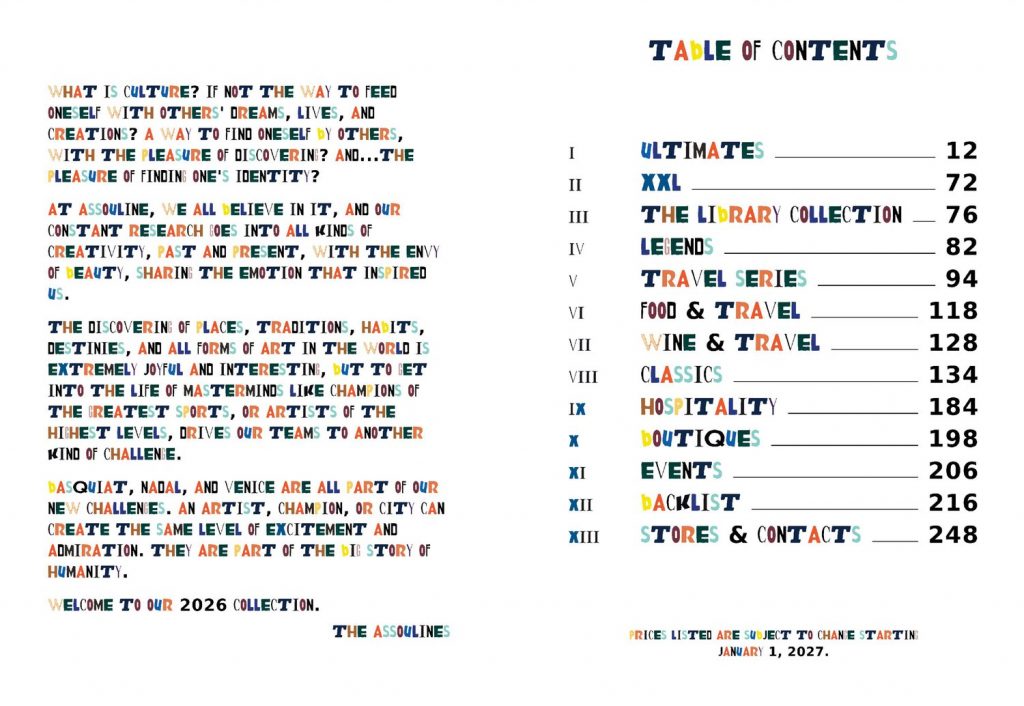
I made versions with and without their backgrounds, then used the alphabet to reset the catalogue’s introduction and contents. This changed its register.
Week 1: the same alphabet, transparent.
The text still described the collection, but its voice became uneven and visibly assembled. The letters no longer supported a single book’s identity; they carried traces of several identities into every line.
Week 1: the catalogue’s introduction and contents, reset in the found alphabet.
Turning the set into a working font let me test it through typing, rather than only arranging a specimen. Its value was not in making a practical replacement for the catalogue’s typography. It was in seeing how much of a book’s visual identity could remain in one extracted character.
Method 2: color
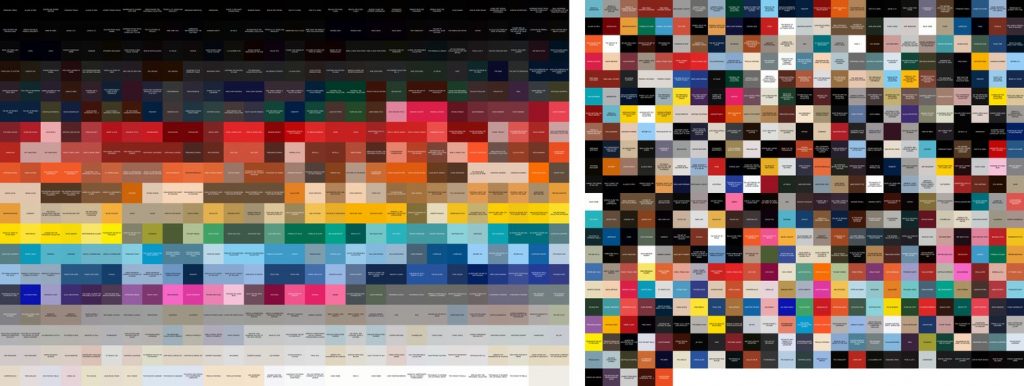
For the color experiment, I reduced the catalogue’s backlist index to 530 flat swatches, with a small title label attached to each one. I arranged the same set twice: once by color and once in the catalogue’s order. Both versions became a grid and a continuous strip.
Week 1: the same 530 swatches as grids, ordered by color (left) and in the catalogue’s own order (right).Week 1: the two sequences as strips, ordered by color (top) and in the catalogue’s own order (bottom).
The color sequence made neighboring books look connected even when their subjects were unrelated. In the catalogue-order version, those smooth transitions broke apart. Comparing the two made the organizing rule visible: the material had not changed, but its apparent relationships had.
The small labels kept a route back to the books. Without them, the sequence could become an abstract image with no need for a catalogue at all. I wanted that tension between the pleasure of the color arrangement and the information it had removed to remain visible.
Method 3: photographic cutouts
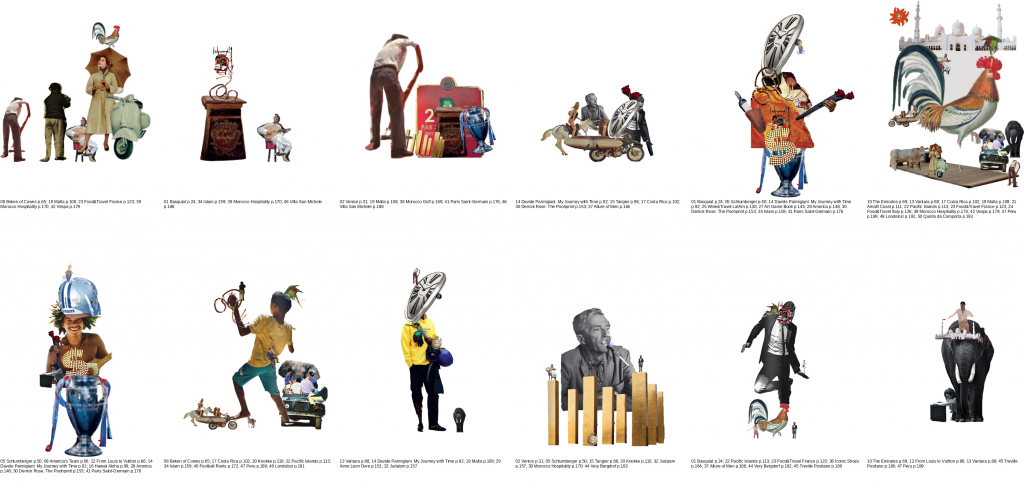
I selected one object from the photography associated with each of 50 featured books. Removing the surrounding scene changed how I looked at the image.
Week 1: photographic cutouts 01–25, in catalogue order.Week 1: photographic cutouts 26–50, in catalogue order.
I then made 12 collages, using overlap and changes of scale to create relationships between objects from different books. The strongest arrangements moved beyond placing objects side by side. One image could interrupt another, become its setting, or change what it appeared to be doing. This continued the compositional work from Skin on Skin, but the fragments now came from a publisher’s collection rather than photographs of myself.
Week 1: twelve collages built from the cutouts.
Method 4: the atlas
The Detail Atlas moved in the opposite direction from the cutouts. Instead of preserving a recognizable object, I enlarged a small part of each photograph until the subject became difficult to identify. The same 50 books became a set of colors, surfaces, and textures.
Week 1: the atlas, details 01–25, in catalogue order.Week 1: the atlas, details 26–50, in catalogue order.
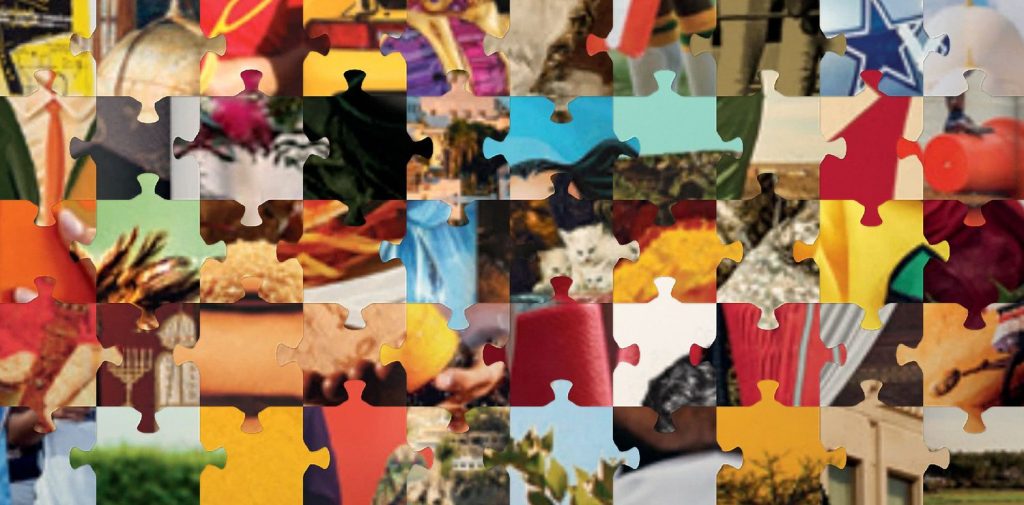
I kept the tiles in catalogue order and also developed them into a jigsaw image. The labels could tell the reader where a detail came from, but the crop alone often could not. Looking became a process of trying to connect a fragment with an absent whole.
Week 1: the atlas cut into jigsaw pieces.
Together, the four experiments showed me how much a catalogue depends on the feature chosen to stand for each item. A title, a color, an object, and a texture could all refer to the same book while offering very different accounts of it. The cutouts gave me the most room to continue: they could retain something recognizable from each publication while allowing another story to form around it.
Week 2: the design diary
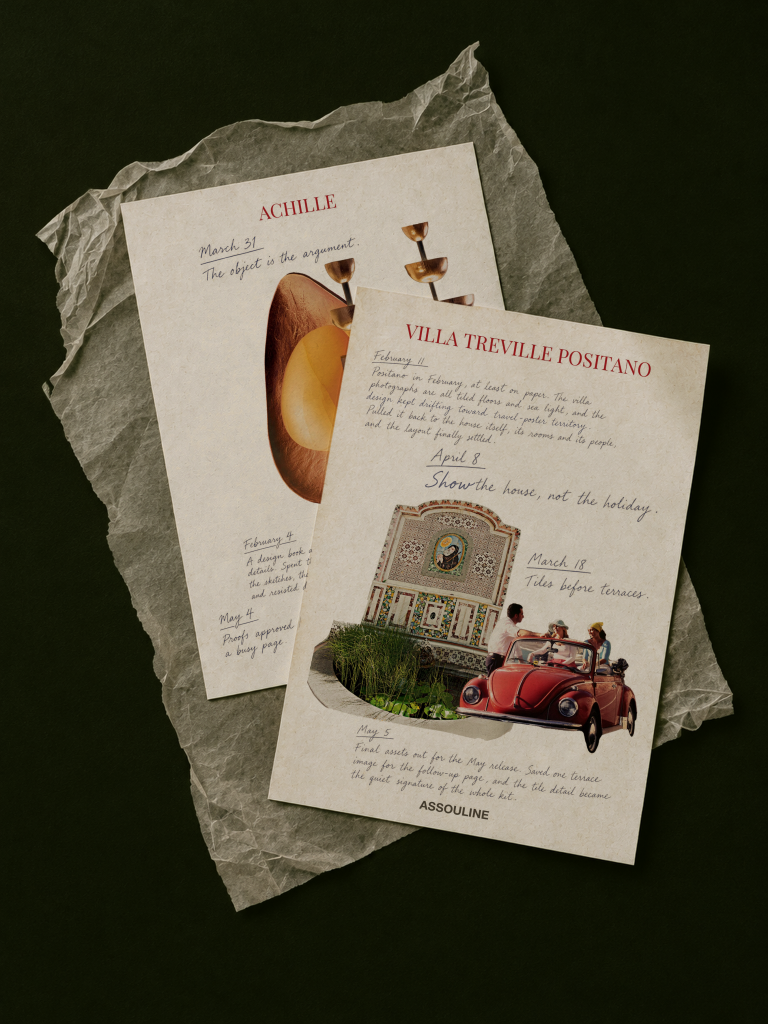
For the next stage, I wanted the photography to carry a story rather than remain a set of visual experiments. My experience at Assouline gave me a way to approach that story from inside the work. Instead of making another catalogue of subjects, I began developing loose, postcard-like sheets that paired imagery from a book with diary-style writing about working on its press materials.
The writing was developed retrospectively for this project, rather than reproduced from an existing journal. I used the diary form to bring a personal voice into a collection usually presented through finished images and carefully edited descriptions. Short entries could sit beside longer reflections, allowing work, mood, and ordinary pauses to share a page. I focused the writing on the smaller decisions and interruptions surrounding press materials, rather than giving each book another promotional description.
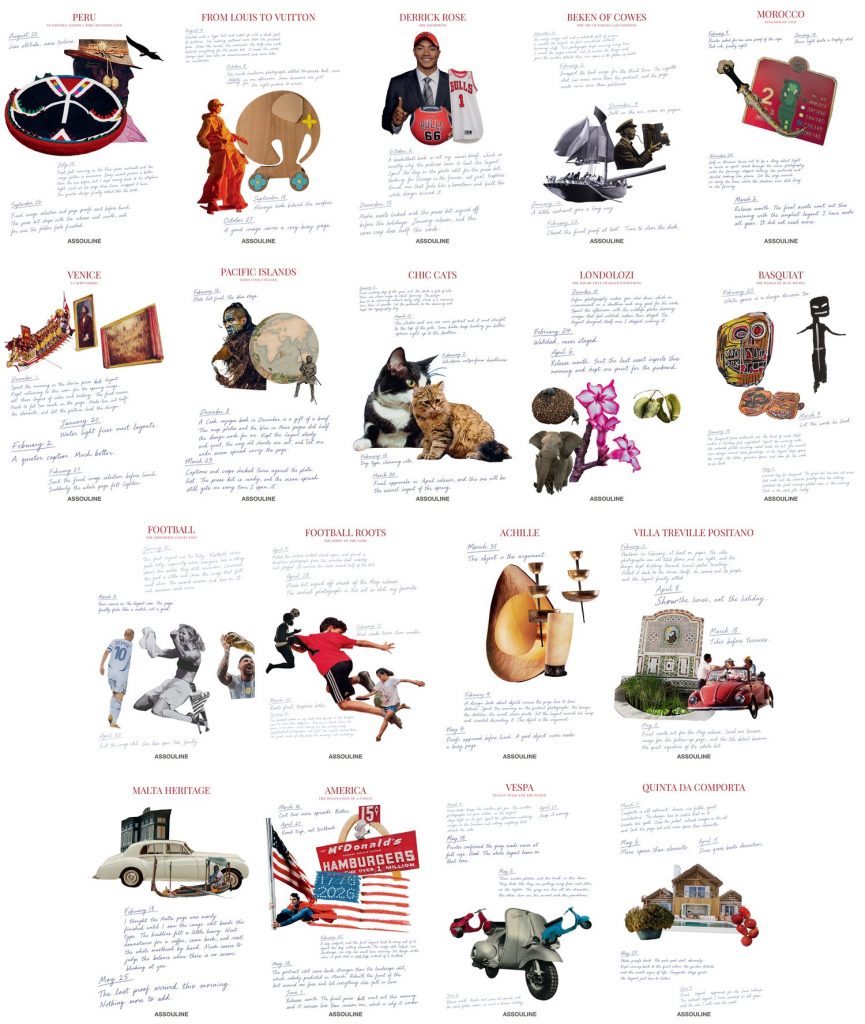
Narrowing the selection to 18 titles released during my time at Assouline linked the collection to a particular period of work. The release dates provided a structure for the entries, while the writing could move between a design decision and a passing thought.
I tested a single cutout and a fuller collage for each title. The collage version gave me more ways to build a page around the character of the book. Unlike the week 1 compositions, which mixed sources, each of these sheets stayed within one publication. The title kept that connection explicit, while the imagery and notes gave the reader more than one point of entry.
Week 2: the diary, sheets 001–018, in order.
I worked toward a layout in which the writing moved around the images rather than sitting in a separate block. The lengths and sizes of the entries varied so the page could hold different rhythms. A brief thought did not need the same space as a longer account, and the image did not have to sit above the writing in a fixed hierarchy.
The collages needed real interaction between their parts. I adjusted scale, overlap, and the balance between image and writing so that the sheets did not become repeated templates. The cutouts stayed flat within the artwork. Depth belonged to the presentation of the paper, not to a shadow making each image look like a separate object.
Week 2: final outcomes
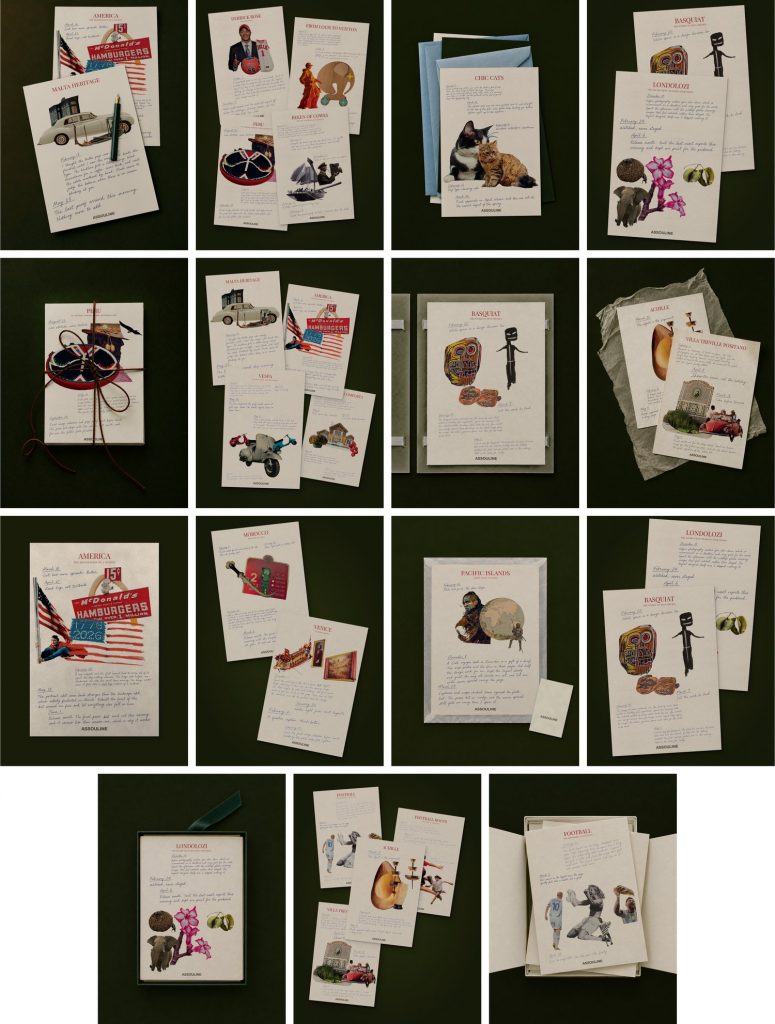
I developed the sheets as singles, pairs, and small groups, using muted paper against a dark emerald background. Texture, light, and soft shadows gave the pages a material setting. Overlapping sheets allowed the collection to appear as something that could be handled and returned to, rather than only read in a fixed sequence.
Week 2: the final outcomes.
Where the project is now
The project has moved from extracting visual features to reconsidering what can hold a collection together. In week 1, the rules came from the catalogue’s visible material: letters, colors, objects, and details. In week 2, my connection to the books became part of the organizing structure. A publication could be approached through the work and personal voice surrounding it, rather than only through its subject.
That shift also leaves a question about how the sheets are read. The diary form suggests intimacy, but it is still a designed representation. Its dates, handwriting, and fragments of thought shape an impression of experience; they are not the experience itself. I want to test how the collection reads when it is physically handled, rather than assume the material feeling of these images is already the experience of the work.
In John Yuyi’s Skin on Skin, nude self-portraits become temporary tattoos on pork skin. She describes the work’s “cyclical nature” (Weinstock, 2018): skin becomes an image placed on another skin. Her question, “Why don’t I put my skin on animal’s skin?” (Weinstock, 2016), sits alongside her later question about what distinguishes human and pig skin through texture alone (Wazaiii, 2018).
Preparing the copy has involved adjusting the image size to fit the meat. This raises a question about the transfer itself: what does it preserve of the person pictured, and what does the new surface change? When does a body remain recognizable as someone’s own, and when does it become a collection of parts to be judged? Does placing the image on meat encourage that judgment, or expose expectations we already bring to images of women’s bodies? Can choosing how a body appears offer control without repeating those expectations?
Using photographs of my own body would let me examine these questions as both subject and viewer. One possibility is to transfer separate body parts onto pork skin, repeatedly changing their order, spacing, and orientation to see when I recognize myself and when the parts seem interchangeable. Alternatively, I could place the same images on pork and my own skin, varying their size and position across both surfaces to explore what makes them feel like mine. A third possibility is to keep an image unchanged while altering its wrapping, label, and price, testing how readily I assess my body as a product. In whichever direction I pursue, photographs and written observations would record these shifts, including responses I had not anticipated.
References
Wazaiii (2018) ‘Wazaiii Give Me 5─John Yuyi五件藝術大作和她如謎一般的創作之旅’, 16 December. Available at: https://www.wazaiii.com/articles?id=interview-John-Yuyi (Accessed: 11 October 2026).
Weinstock, T. (2016) ‘Yuyi John is the Willy Wonka of the art world’, i-D, 11 August. Available at: https://i-d.co/article/yuyi-john-is-the-willy-wonka-of-the-art-world/ (Accessed: 11 October 2026).
Weinstock, T. (2018) ‘The Instagram artist turning her social media addiction into art’, i-D, 21 February. Available at: https://i-d.co/article/the-instagram-artist-turning-her-social-media-addiction-into-art/ (Accessed: 11 October 2026).
Draft 2
Skin on Skin (2016) asks what happens to the image of the body when it is transferred onto animal skin. In my iterations, I transfer photographs of my own body onto pieces of meat; my question is whether the person remains in that image, or whether the body is reduced to separate parts.
Eva Stenram’s Drape gives me a way to examine what it means to read a body as parts. Stenram scans vintage pin-up photographs of women and digitally extends the curtains behind them to partly conceal their bodies. She writes: “Once the backdrop falls in front of the model, showing just parts of her body, our voyeuristic desire becomes clearer” (Stenram, n.d.). In her account, concealment does not hide the body so much as expose the viewer’s desire to look at it. For my project, this raises a distinction between physically separating my image and directing attention toward separate parts of my body. The cuts will divide the image, but they cannot determine how someone looks at it.
Where Stenram interrupts the visibility of an existing figure, I am trying to restore a figure after separating its image. I will reconstruct the photographed image of my body on pieces of meat, keeping the pose as close to the original as I can. Yet a recognizable outline would not settle the matter. Someone could follow the pose across the pieces while still reading an arm or a leg as an isolated object; the meat underneath gives each transferred section a separate physical boundary.
Stenram’s exchange of foreground and background also makes me reconsider the surface carrying my image. Her curtains move forward and interfere with the figure. In my work, the meat cannot be treated as a neutral background either; its texture, edges, and associations could compete with the photographed body for attention. Rebuilding the pose faithfully will not remove those differences: the seams may hold the figure together visually while keeping the separate pieces apparent.
Unlike the found photographs in Drape, my images begin with choices I make about my own body: how to pose and where to divide the image. That gives me control over making the representation, but not over how it is received. Even a pose I choose could become a way of displaying individual body parts once transferred and divided.
Drape helps me distinguish the physical fragmentation of my image from the possible reading of my body as an object. In the reconstructions themselves, I want to look beyond whether each pose matches: whether the separate surfaces encourage attention to move across my body or settle on particular parts, and what becomes of my self-image in that shift.
Stenram, E. (n.d.) Drape. Available at: https://www.evastenram.net/drape (Accessed: 20 October 2026).
Draft 3
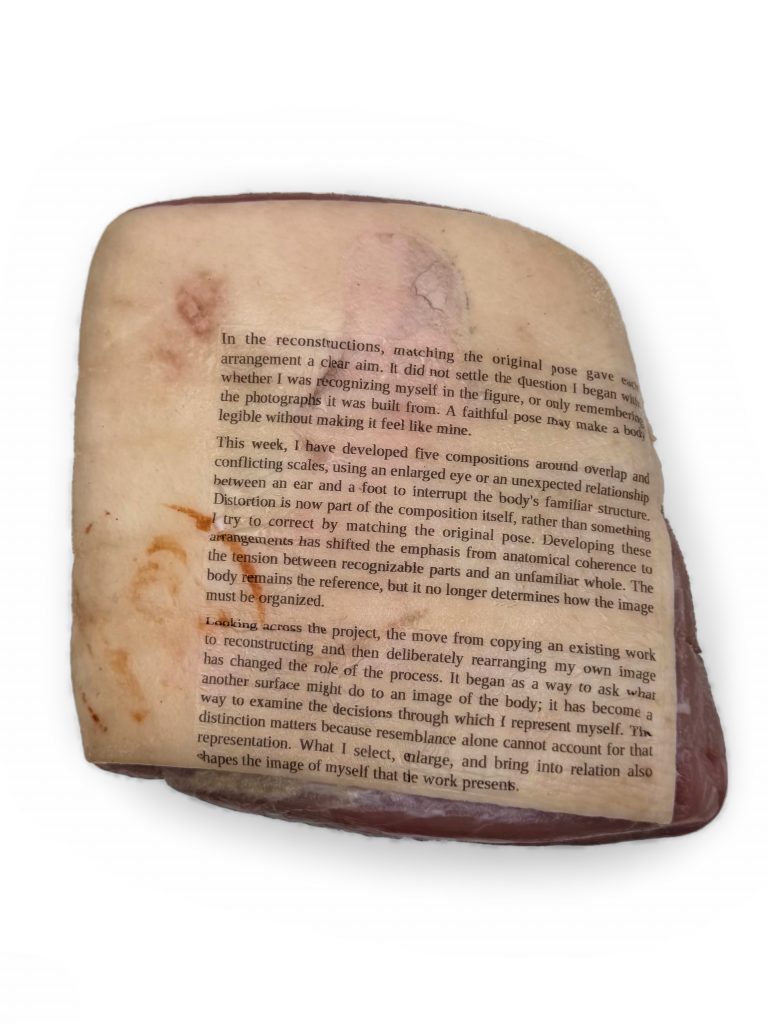
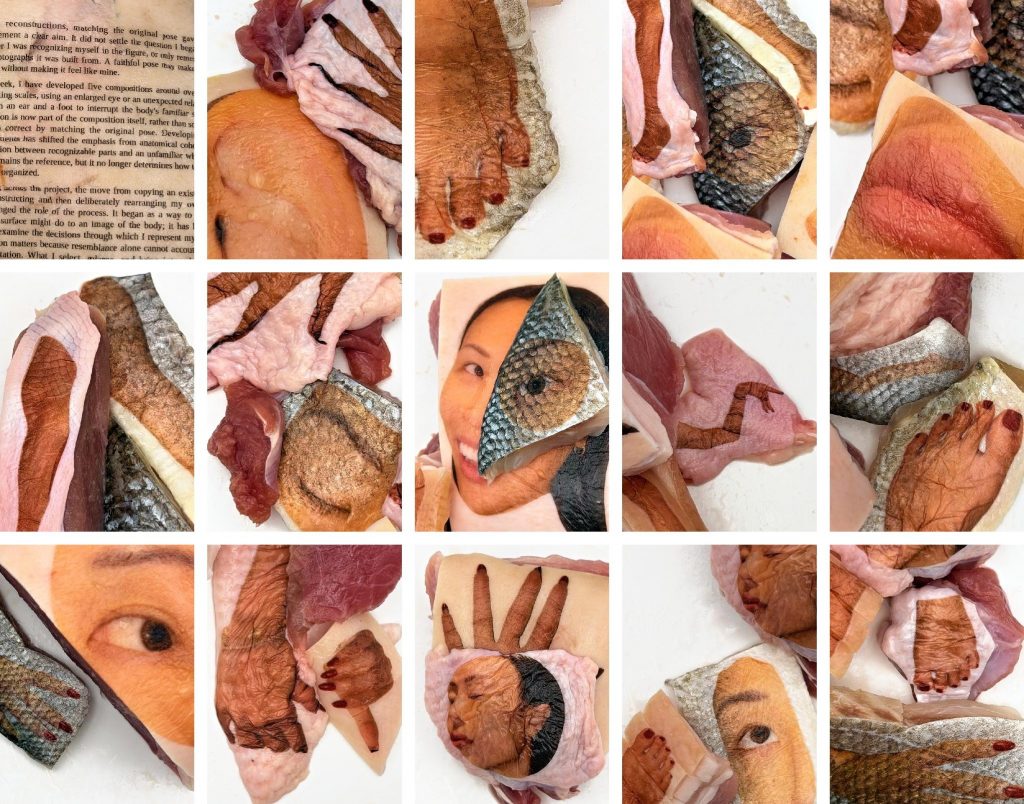
In the reconstructions, matching the original pose gave each arrangement a clear aim. It did not settle the question I began with: whether I was recognizing myself in the figure, or only remembering the photographs it was built from. A faithful pose may make a body legible without making it feel like mine.
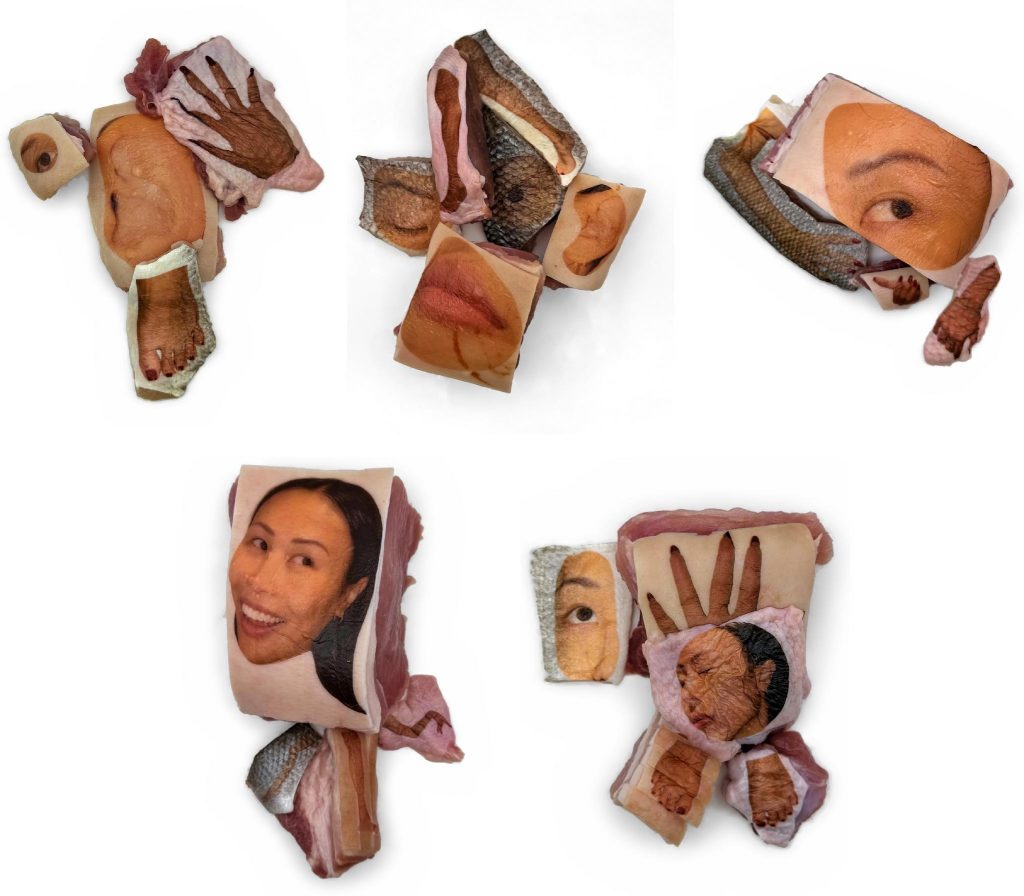
This week, I have developed five compositions around overlap and conflicting scales, using an enlarged eye or an unexpected relationship between an ear and a foot to interrupt the body’s familiar structure. Distortion is now part of the composition itself, rather than something I try to correct by matching the original pose. Developing these arrangements has shifted the emphasis from anatomical coherence to the tension between recognizable parts and an unfamiliar whole. The body remains the reference, but it no longer determines how the image must be organized.
Looking across the project, the move from copying an existing work to reconstructing and then deliberately rearranging my own image has changed the role of the process. It began as a way to ask what another surface might do to an image of the body; it has become a way to examine the decisions through which I represent myself. The distinction matters because resemblance alone cannot account for that representation. What I select, enlarge, and bring into relation also shapes the image of myself that the work presents.
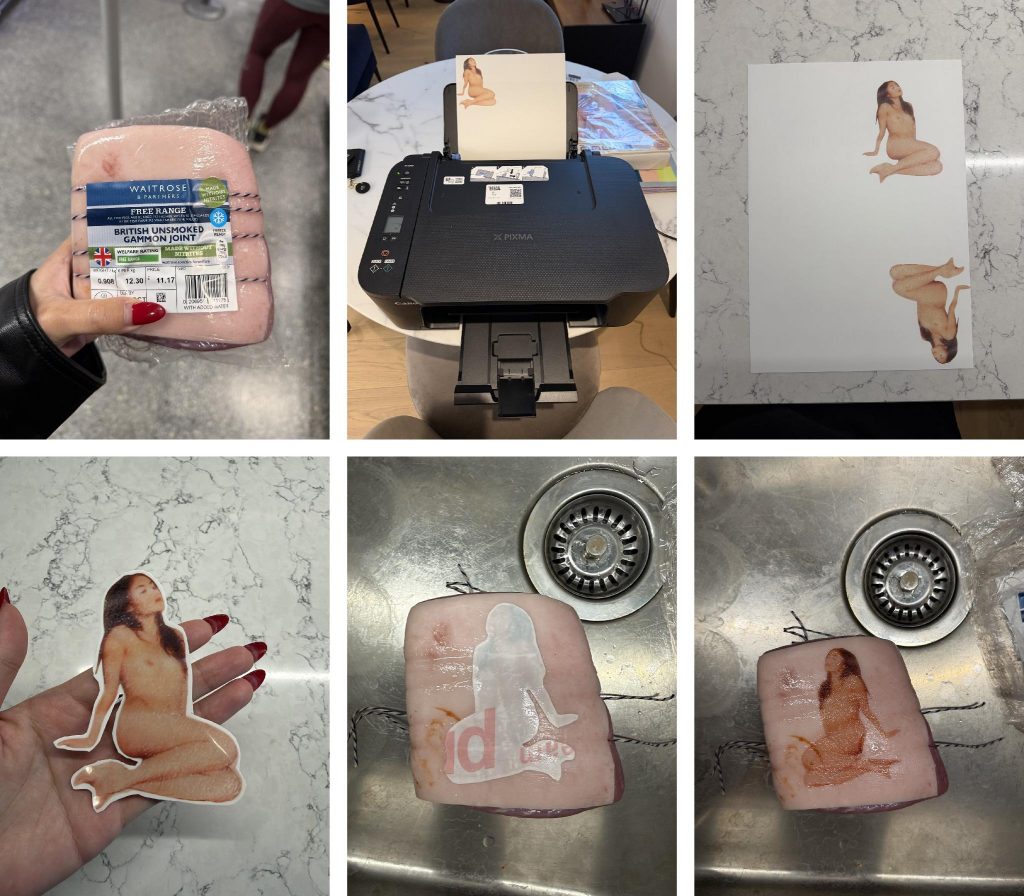
For this brief, I chose to remake John Yuyi’s Skin on Skin (2016). In that project, Yuyi turns nude self-portraits into temporary tattoos and transfers them onto skin-on pork, then photographs the result. A person’s skin becomes an image, and that image is laid onto another skin.
The questions I wanted to pursue came from putting myself in her position. What of the person pictured survives the transfer, and how does the new surface change it? At what point does a body stop being someone’s own and become a set of parts to be judged? A woman’s image on meat can make the body look like a product. I wanted to know whether deciding how my own body appears could give me some control, or whether it would only repeat the ways women’s bodies are already looked at.
Photographing my own body would put me on both sides of those questions, as the person pictured and the person looking. But the first step was the copy itself: remaking Yuyi’s work as closely as I could, in a medium I had never used.
Week 1: making the copy
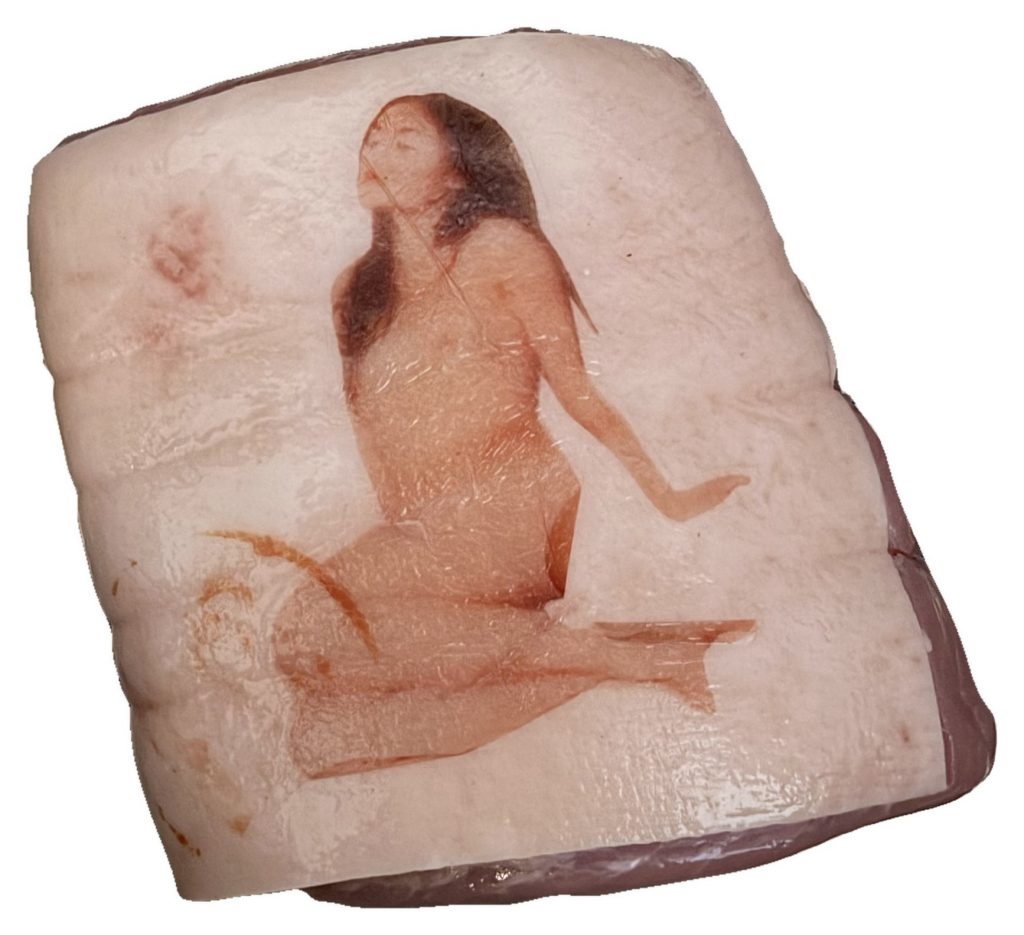
I printed one of Yuyi’s portraits onto temporary tattoo paper with a home inkjet printer, mirrored so the image would read correctly once transferred. My first print came out faded because I had printed on the wrong sheet, and a later attempt trapped air bubbles inside the transfer layers. The transfer that worked went onto pork skin, and I photographed the result against a plain white background, the way Yuyi presents her own photographs.
The copy: Yuyi’s portrait transferred onto pork skin.Week 1: progress shots, from the printed sheet to the finished transfer.
One successful transfer was enough for the copy, but not for the project. The feedback after my first presentation pushed the work further: the method was quick to pick up, and a single transfer did not test it. The next stage had to build process and repetition into the work, many transfers rather than one, while keeping the tattoo method at its center.
Week 2: reconstructing the body
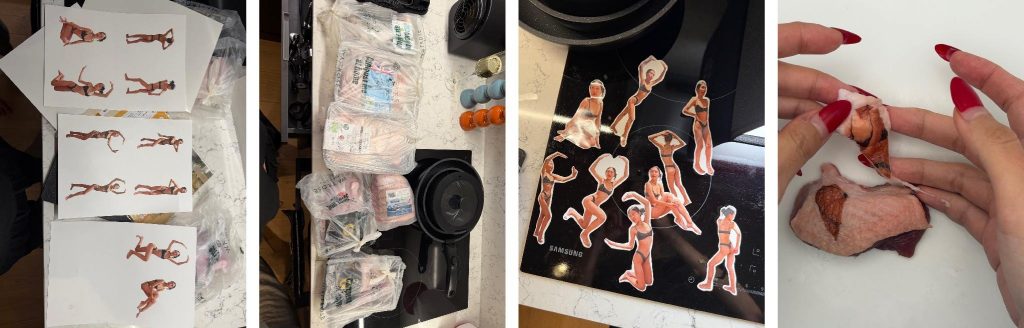
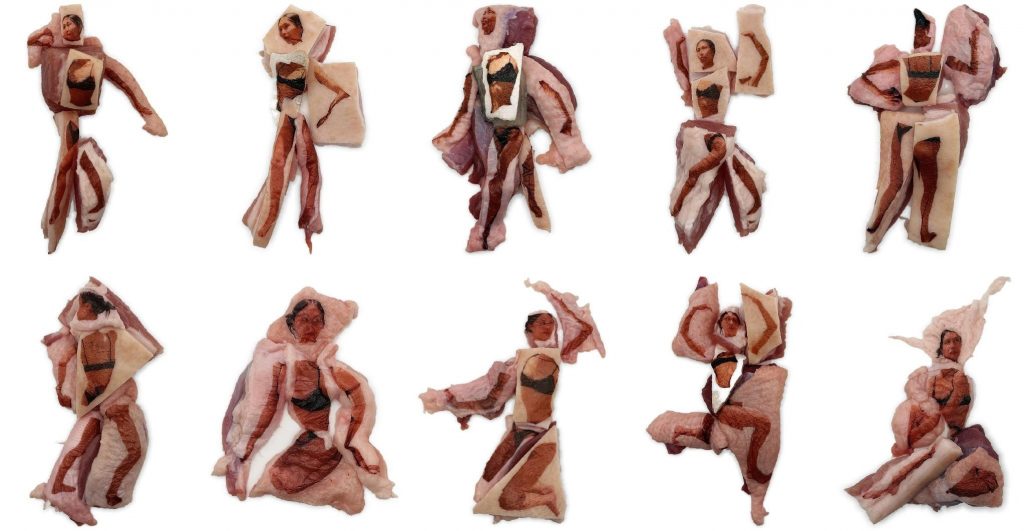
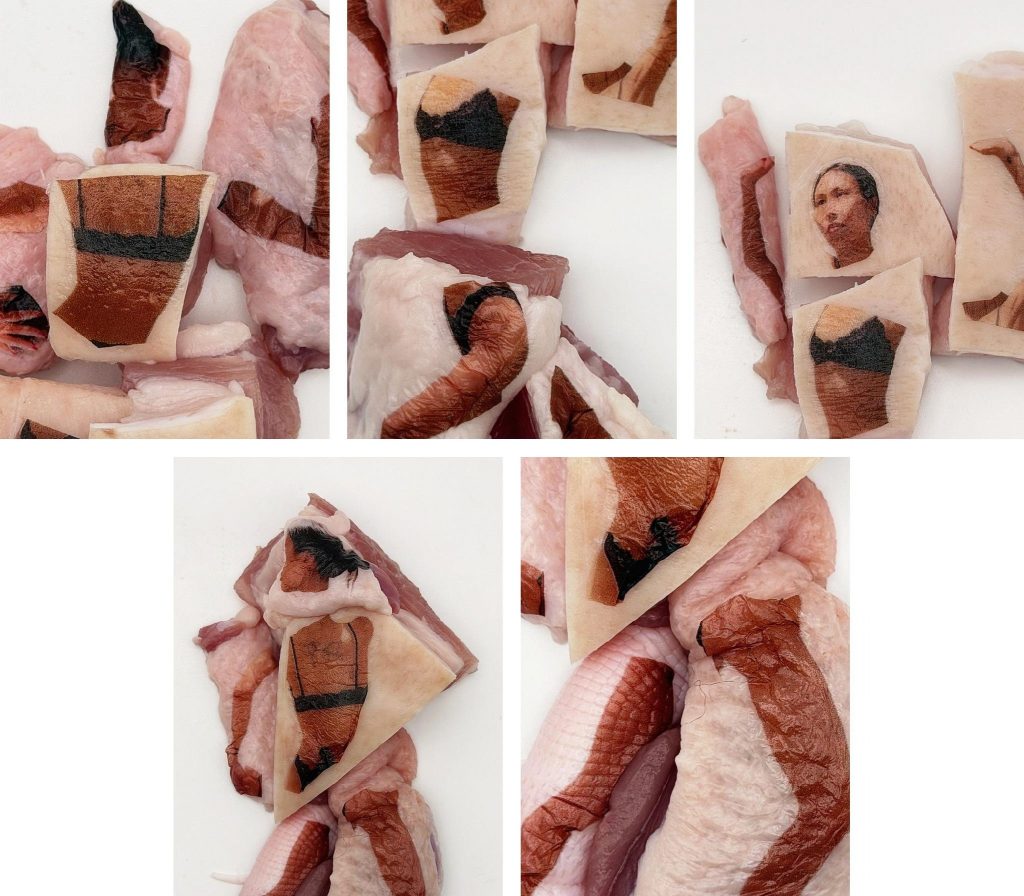
I photographed myself in ten poses selected from Andrew Loomis’s Figure Drawing for All It’s Worth, working from more open arrangements toward poses with more bends, twists, and overlapping parts. I cut each printed photograph into six anatomical sections: the head and neck, the torso, two whole arms, and two whole legs. Each section was transferred onto its own small piece of meat, using different animals across the pieces. I then arranged the pieces to reconstruct each original pose as closely as I could, producing ten outcomes.
Week 2: applying the transfers, section by section.
This pushed the question from the copy further: what of the person pictured survives the transfer, and how does the new surface change it? Rather than deliberately distorting my body, I tried to keep it recognizable while the pieces of meat cut it apart. The cuts, gaps, and differences between the pieces could make some parts more prominent or harder to connect. I wanted to know whether the reconstructed image still read as a person, or whether it asked people to look at individual parts instead.
Alongside the making, I was reading Eva Stenram’s Drape, a series where parts of women’s bodies disappear behind digitally extended curtains. It helped me separate two things the reconstructions were doing at once: physically dividing my image, and directing how someone looks at it. The cuts could divide the image; they could not determine how it would be read.
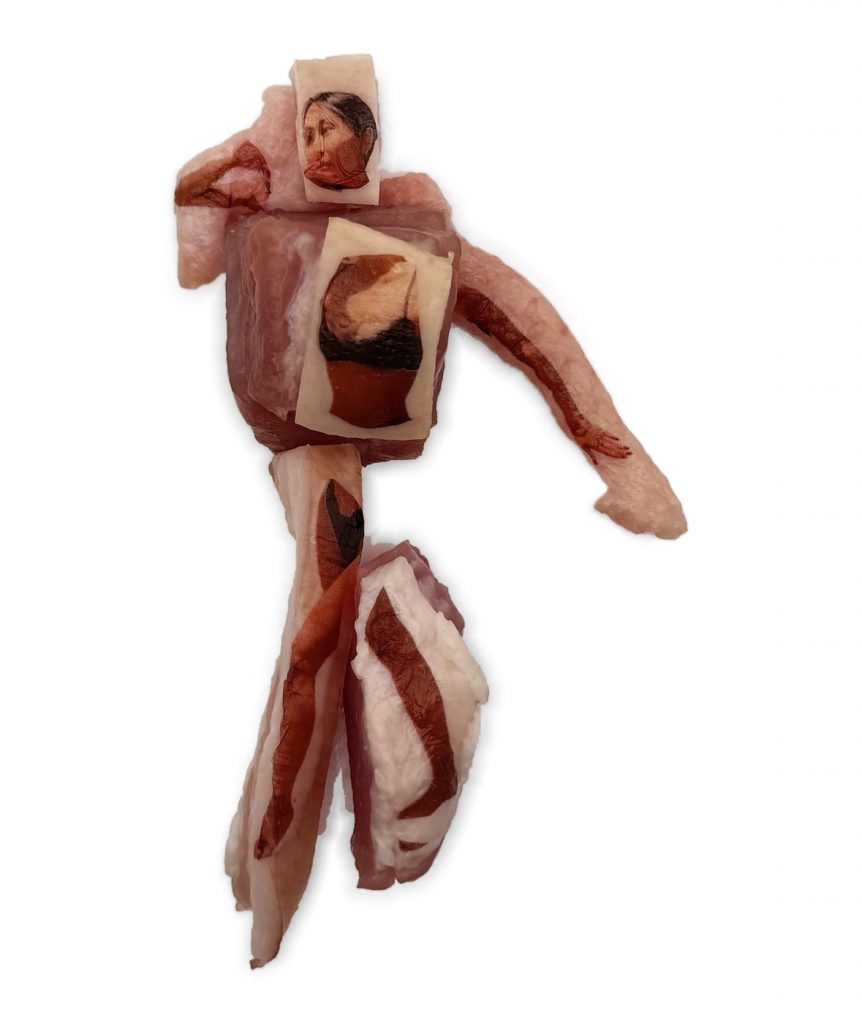
Week 2: the ten reconstructions, each pose rebuilt from six transferred sections.Week 2: reconstruction 1 at full size.Week 2: details.
Looking at the ten outcomes, I kept returning to the difference between recognizing parts of myself and recognizing myself as a whole. The transfer preserves familiar details of my face, skin, and clothing, but changes how they appear; the meat’s own colors, fat, and folds stay visible alongside the print. A fragment can remain identifiable without restoring the person it came from, and a readable pose does not necessarily make the figure feel like me. I was left asking whether I was recognizing myself, or connecting the fragments because I already knew they belonged together.
Week 3: rearranging the body
Matching the original pose had given each reconstruction a clear aim, but it left my question open: did I actually recognize myself in the figure, or did I only remember the photographs it was built from? For the final week, I stopped rebuilding the body and started rearranging it.
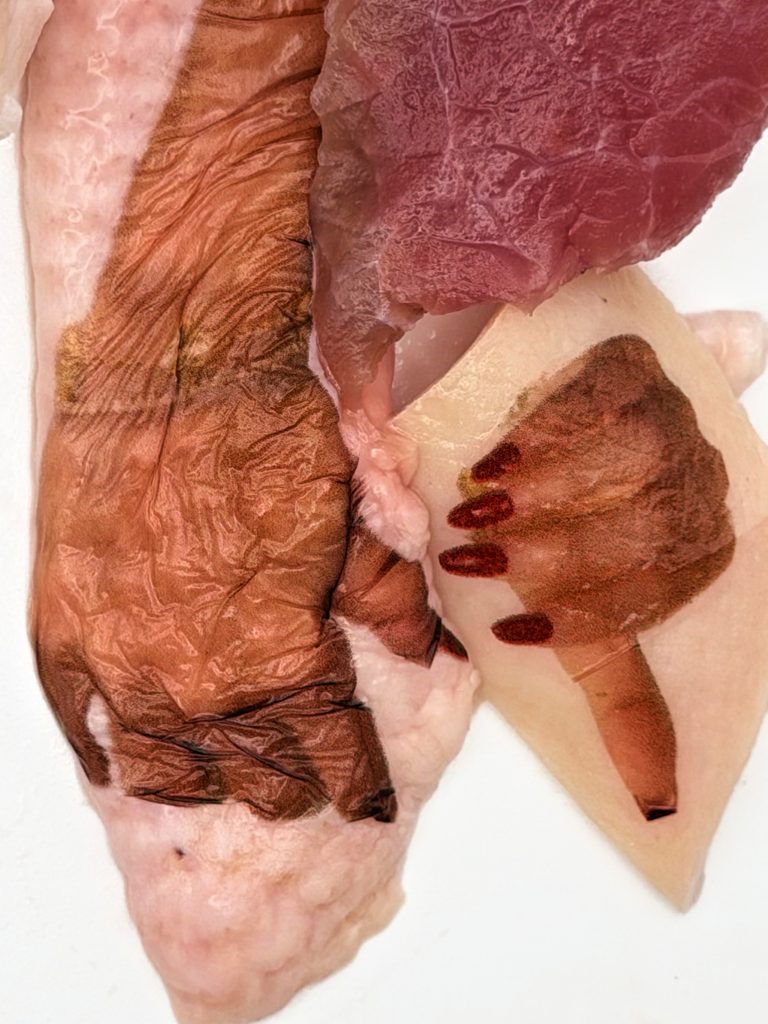
I took new photographs of my own body and made five compositions, each built from four to six pieces, with every photograph transferred onto skin-on meat. Referencing Hannah Höch’s collages, I let the pieces overlap and collide at conflicting scales: an enlarged eye, a foot meeting an ear. Each composition stays recognizable and unfamiliar at once. Distortion became something to compose with, rather than a flaw to fix against the original pose. The body is still the reference, but it no longer dictates how the image has to be arranged.
Week 3: the five compositions.
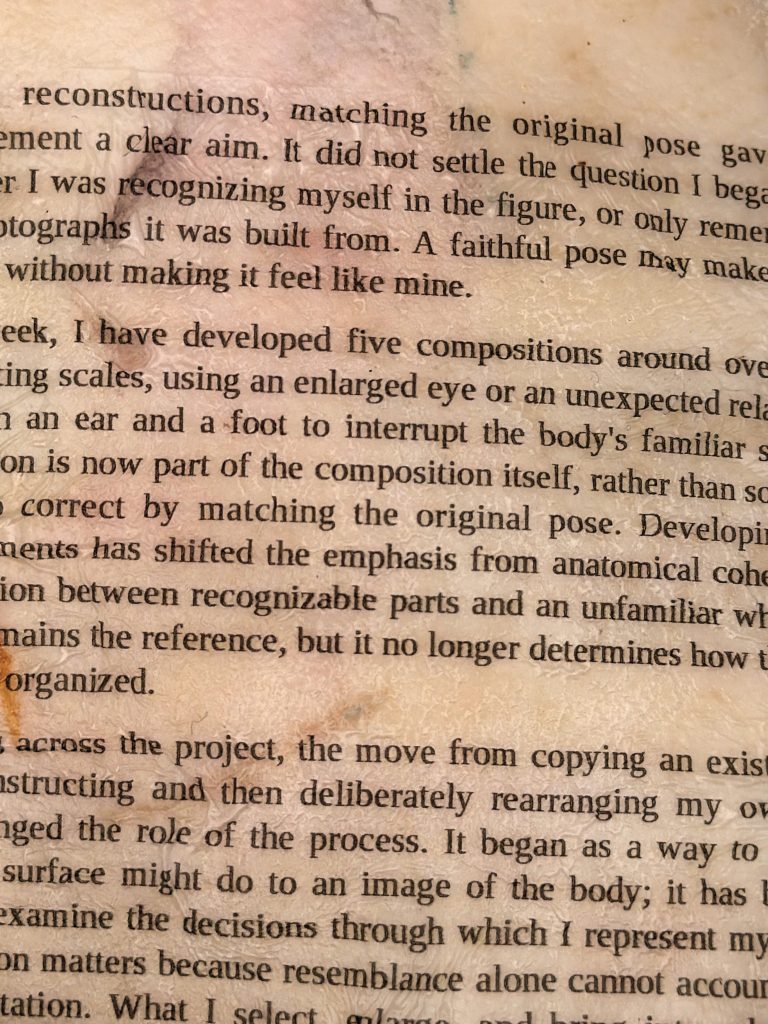
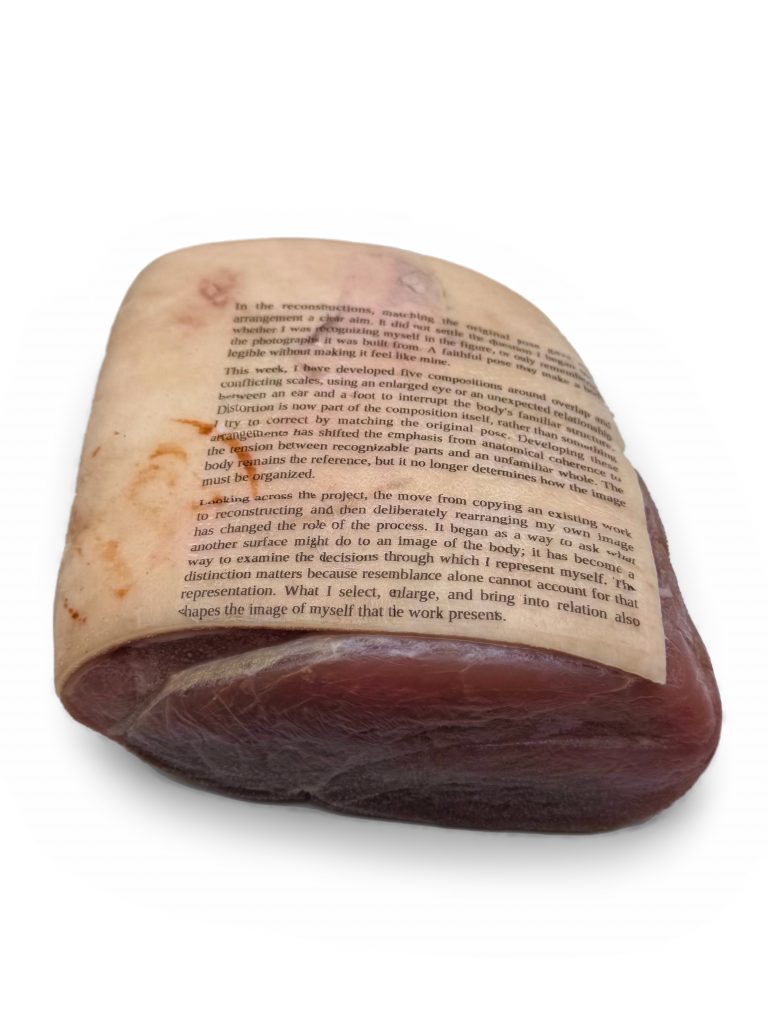
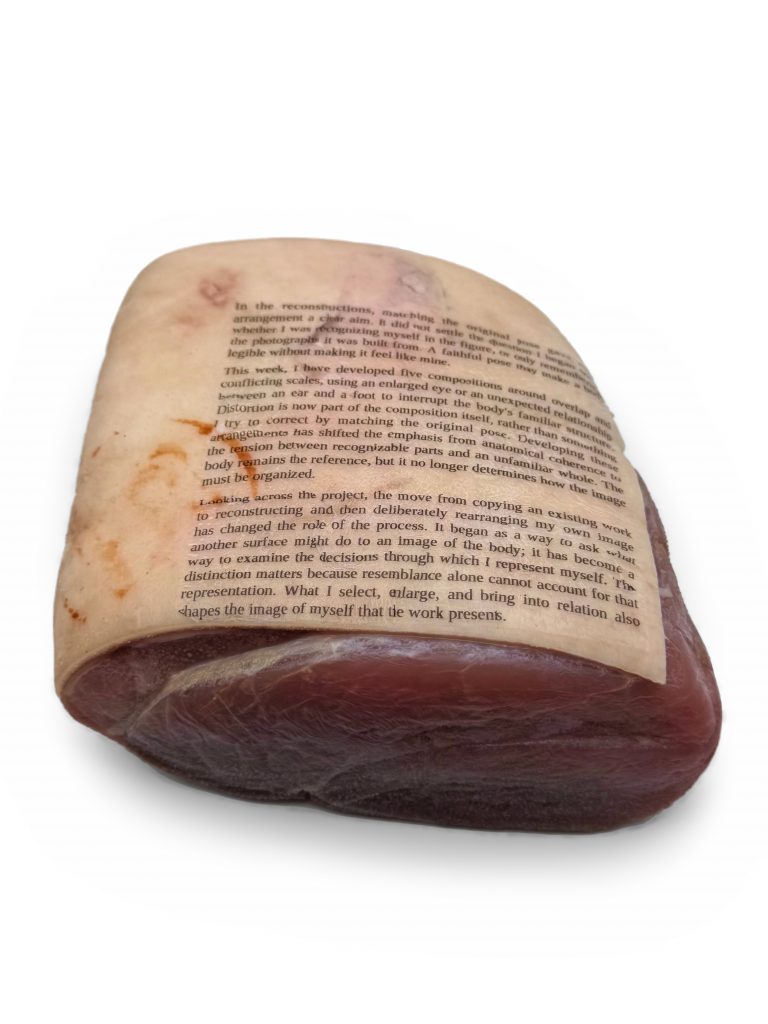
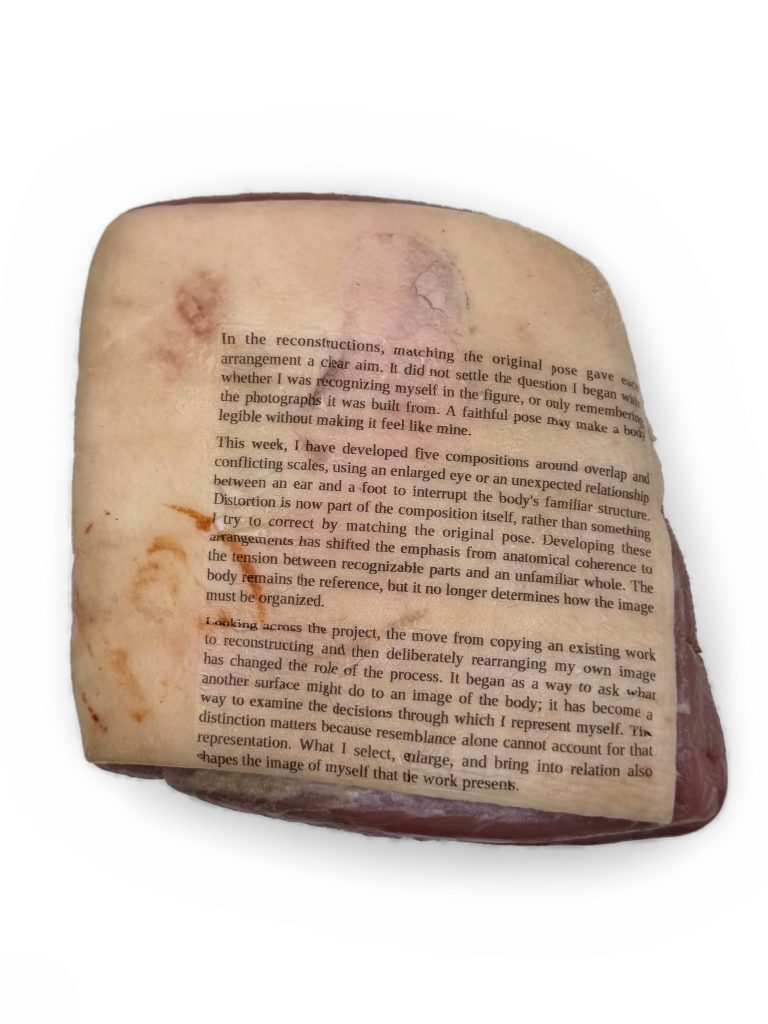
The writing entered the medium as well. The final draft of my written response, covering this last week’s progress and reflecting on the project as a whole, was printed and transferred onto a piece of pork skin.
Week 3: the written response transferred onto pork skin.Week 3: the transferred text, close-up.Week 3: details.
Where the project is now
Over three weeks, the project moved from copying an existing work, to rebuilding my own image from pieces, to deliberately rearranging it. The project started by asking what a different surface could mean for an image of the body, and it has become a way to look at the decisions I make when I represent myself. A likeness alone is not the whole picture: what I select, enlarge, and place next to each other also shapes the image the work presents of me. The question I am left with is where recognition actually sits: in the photograph, in the surface beneath it, or in the person doing the looking.
A credit card falls. Another passenger notices. A woman changes her shoes and rushes onto the train. What interests me about these moments is how much happens within what we call waiting. My project looks at one bench on the Victoria line platform at King’s Cross St. Pancras. I wanted to understand the rhythm of waiting through the people using this small space.
Georges Perec’s ‘The Street’ offers a way into studying that rhythm through process, since it asks the observer to stay with what is ordinary until it becomes visible. His instruction to slow down invites a second look at surroundings that familiarity makes easy to overlook (Perec, 1974). My usual experience of the platform is directed toward departure, because I leave when a train arrives. Attending to the activity within the platform, rather than to my own journey, changed what I looked for. The value of Perec’s approach lies in more than noticing small details. It interrupts a habitual way of seeing in which a place is understood mainly through what I need from it.
Shannon Mattern’s ‘Infrastructural Tourism’ gives the project its theme: infrastructure as something to be made perceptible. She discusses practices that reveal these systems, including the Los Angeles Urban Rangers’ explorations of everyday habitats (Mattern, 2013). Her emphasis on making systems visible encourages me to consider the bench as part of a network rather than a separate object. A transport system is associated with circulation, but the bench accommodates the stillness within that circulation. From this perspective, sitting and waiting are not outside the life of the network. They are part of how it is inhabited. The platform becomes a shared environment with uses that exceed the immediate task of boarding a train.
The two readings change different aspects of my understanding. Perec helps me suspend my usual purpose as a passenger; Mattern prevents that pause from becoming detached from the system around it. Together, they suggest that the distinction between passing through a place and inhabiting it is less clear than it first appears. A brief stay can still involve attending to personal needs or becoming aware of someone else. My observations do not explain the motives behind the actions I recorded, but they challenge the idea that waiting is simply unused time. The bench provides a point from which to examine how people make use of an interval that is temporary, shared, and part of a journey.
References
Mattern, S. (2013) ‘Infrastructural Tourism’, Places Journal, July. Available at: https://placesjournal.org/article/infrastructural-tourism/ (Accessed: 8 October 2026).
Perec, G. (1974) ‘The Street’, ‘The Neighbourhood’ and ‘The Town’, in Species of Spaces and Other Places.
I chose the second bench on the left on the Victoria line platform at King’s Cross St. Pancras. A bench is somewhere to sit and wait, but on a platform the waiting is constantly interrupted. People arrive, settle for a few minutes, and leave when the train comes. Usually I am part of that movement. For this project, I stayed.
I wanted to look at how people behave while they wait and the rhythm behind it. Rather than trying to observe the whole station, I focused on the people using this one bench. The fixed location gave me a way to return to the same small space while the people and their actions kept changing.
At first, I paid attention to what caught my eye: what someone was carrying, what they were doing with their hands, whether they were talking or sitting quietly. I explored three ways of recording the site: objects, written notes, and sound. Each method kept something different. I wanted to understand what it made visible and what it left out.
Week 1: three methods
Method 1: objects
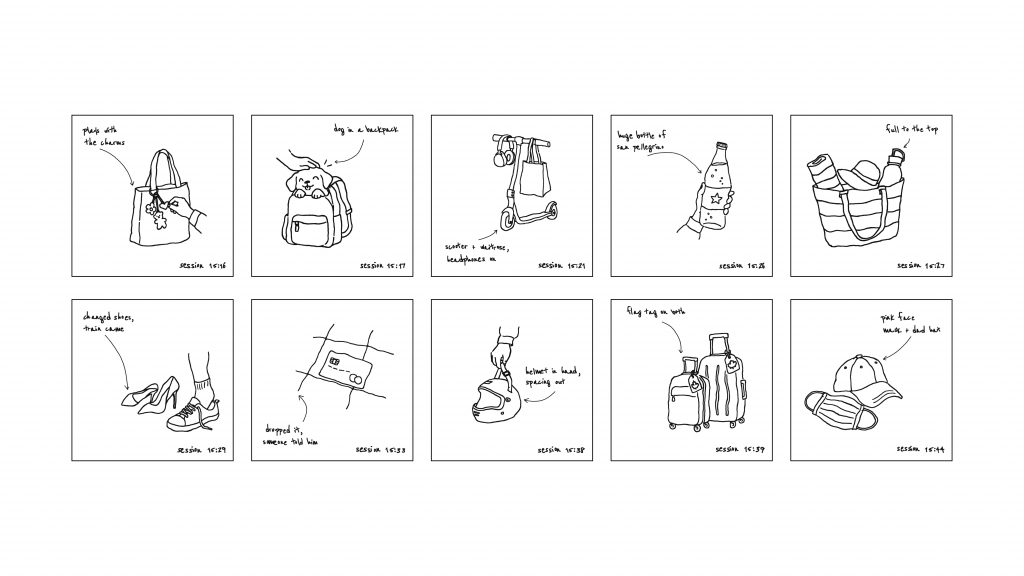
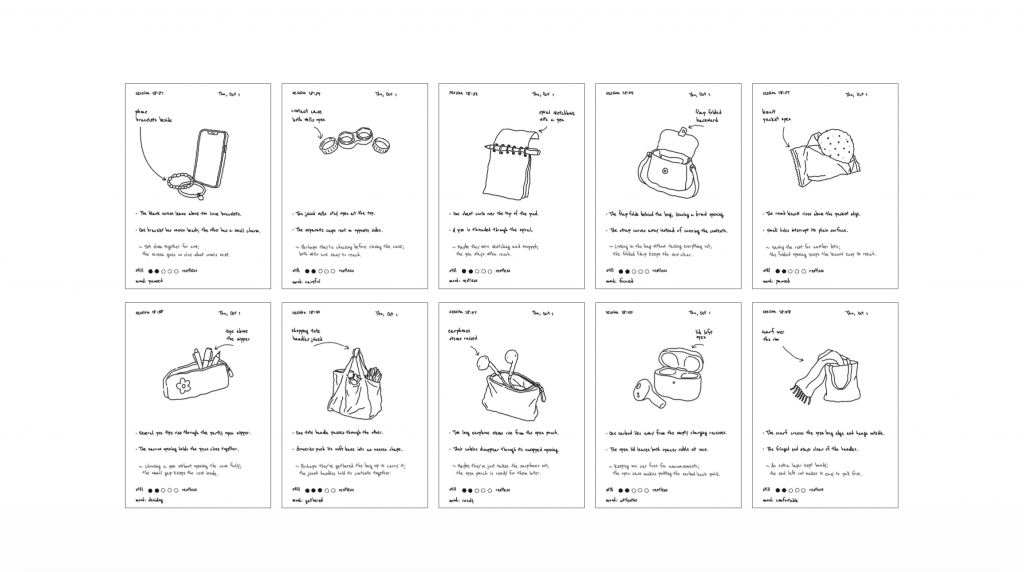
The first method focused on objects people carried. My notes included coffee, backpacks, phones, takeout food, suitcases, a scooter, and a motorcycle helmet. I developed simple line drawings from selected details rather than portraits of the people themselves.
The object became more interesting when something happened around it. A student played with the charms on her bag. A man stroked a dog in his backpack. A woman changed her shoes just before the train arrived and rushed on after putting them on. These moments kept bringing me back to the relationship between an object and an action. A drawing could keep the bag or the shoes, but a short note was needed to keep what made me notice them.
I wanted the visual language to feel quick and informal, with loose lines and small annotations. I kept asking for simpler drawings rather than polished sketches. The images needed to work as a record of attention, not as detailed illustrations of everything in front of me.
Week 1: object drawings developed from selected details in my notes. The session times were added afterward.
Method 2: notes
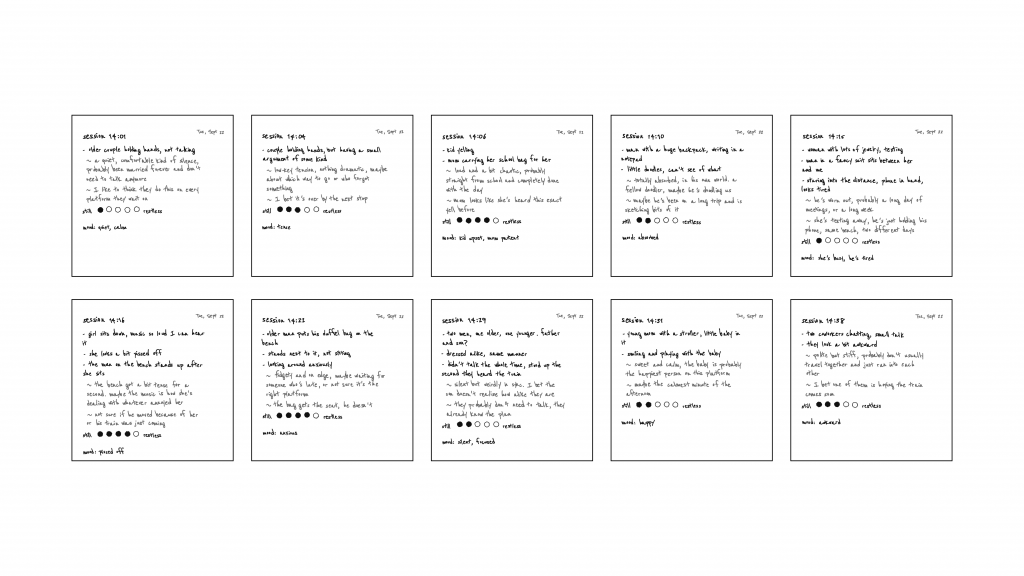
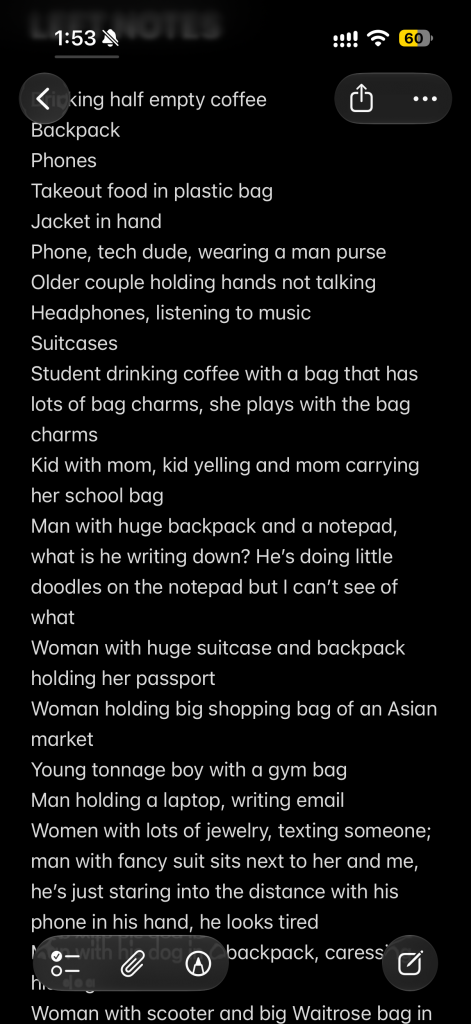
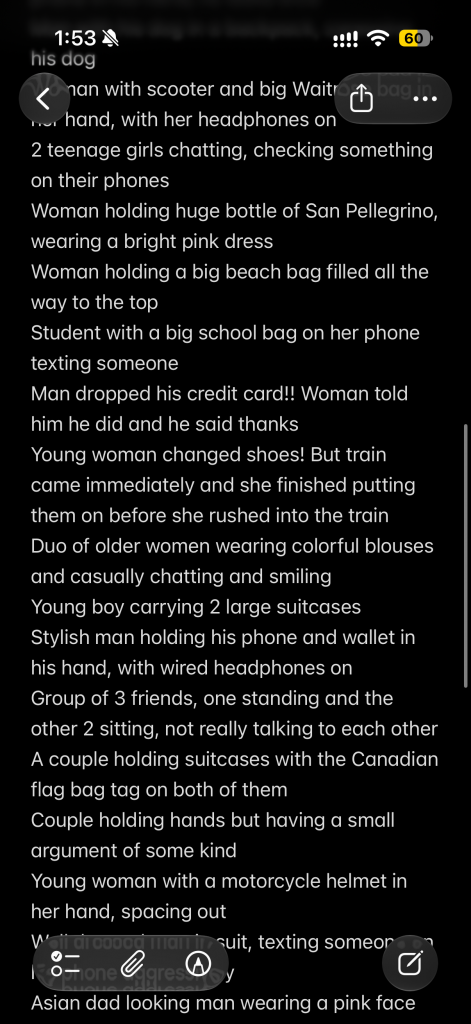
Writing let me keep gestures and interactions that an object drawing could not hold on its own. My original notes moved between short lists and longer accounts: an older couple holding hands without talking, two teenage girls looking at something on their phones, and a passenger dropping a credit card before someone told him.
Looking back at these notes, I noticed how quickly I moved from observation into interpretation. I could see a man staring into the distance with his phone in his hand, but describing him as tired was already a reading of his posture. I could see someone using a notepad, but I could not see what he was drawing. These gaps became part of the project rather than something I needed to fill.
The note-card format included descriptions, possible interpretations, moods, and a still-to-restless scale. The mood and scale were my impressions, not measurements of someone’s internal state. I wanted the reader to see that difference, rather than take my impressions as facts.
Week 1: the notes developed into cards. Descriptions and possible interpretations appear together; the individual times were assigned afterward.
My original observation notes: objects, actions, and first impressions.
The notes continue: a dropped credit card, a shoe change, conversations, and belongings.
Method 3: sounds
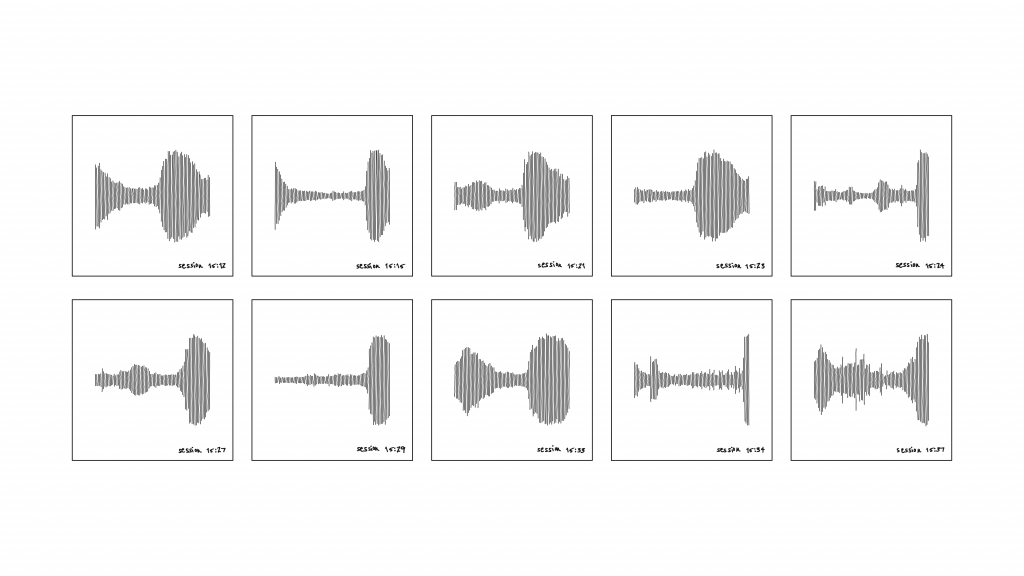
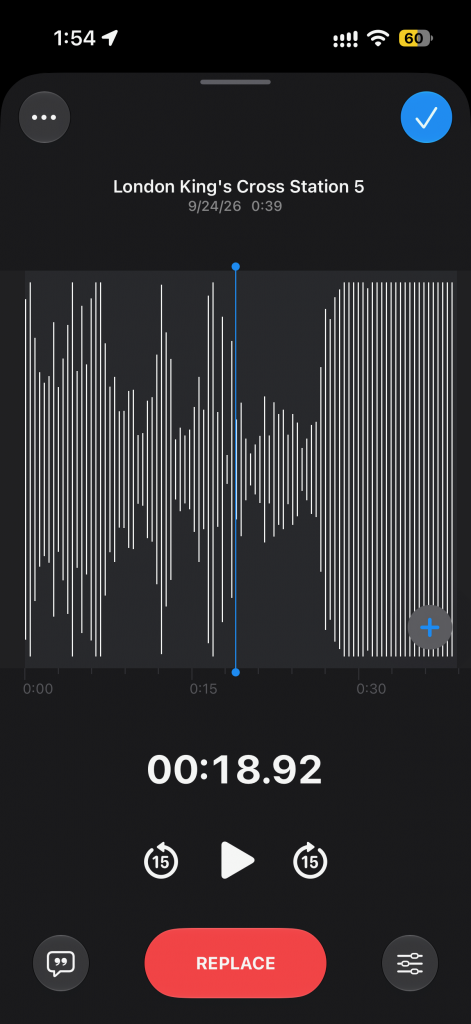
For the third method, I made short voice recordings at the site. The recordings gave me another record to return to, separate from what I had chosen to write down. I developed waveform drawings from the audio so changes in sound level could sit alongside the objects and written notes.
The waveform was a different kind of image: it showed quieter and louder sections without explaining everything that produced them. I did not want to treat the shape as proof of a particular event. It kept the changing intensity of the recording, while the audio remained the source to listen to.
By the end of the week, I had three sets of ten images for the presentation: object drawings, note cards, and waveform drawings. The methods were carried out on separate days, so they were different views of the site rather than three records of the same encounter. The original voice recordings retain their recording times. I had not timed the object and note observations individually, so the times later added to those presentation cards were assigned rather than recorded at the moment.
Week 1: waveform drawings developed from the recordings.
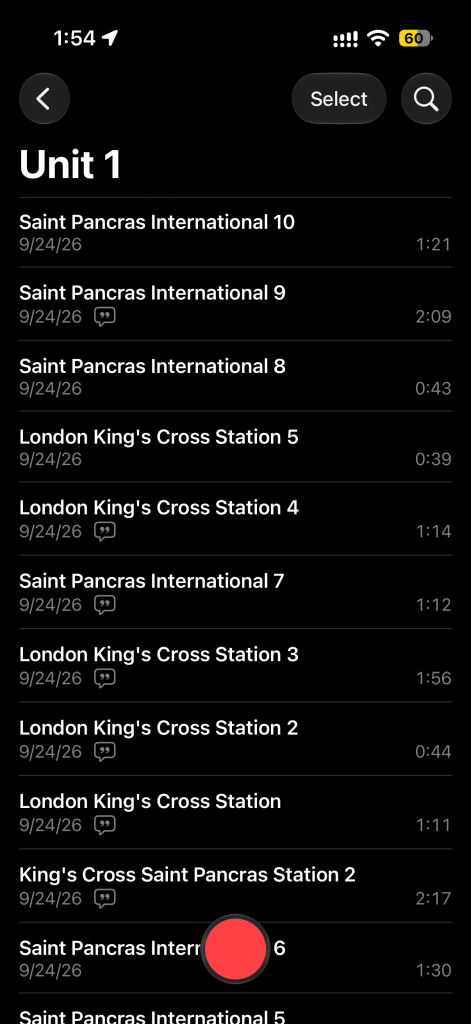
My Unit 1 Voice Memos folder. These recordings are dated September 24, 2026.
An original recording open in Voice Memos: London King’s Cross Station 5, September 24, 2026, 0:39.
Week 2: combining drawing and writing
For the next stage, I brought the object drawings and written notes into one card format. They felt inseparable. The drawing kept the object; the writing kept the action around it.
I returned to the bench across three sessions: September 29 from 7 to 10 a.m., September 30 from noon to 3 p.m., and October 1 from 4 to 7 p.m. Working across different parts of the day gave me a broader basis for looking at the site. I wanted to build volume so that the project would not depend on a single striking moment.
The presentation brought together 150 selected cards. Each paired an object image with a short description and a possible interpretation, followed by a mood and still-to-restless scale. The format made me think about how I separated observation from interpretation. What was visible? What was I suggesting? What would a reader assume from the words I chose?
The cards are developed representations, not a verbatim transcript of every person who used the bench. The original notes and recordings remain important alongside them. The distinction matters because an orderly page can look more certain than the observation it came from.
I also worked on a related-practice section for the presentation. This helped me connect the project to questions about attention, selection, and how an observation becomes something another person can read. The research needed to sit beside my process rather than become a separate collection of references with no connection to the work.
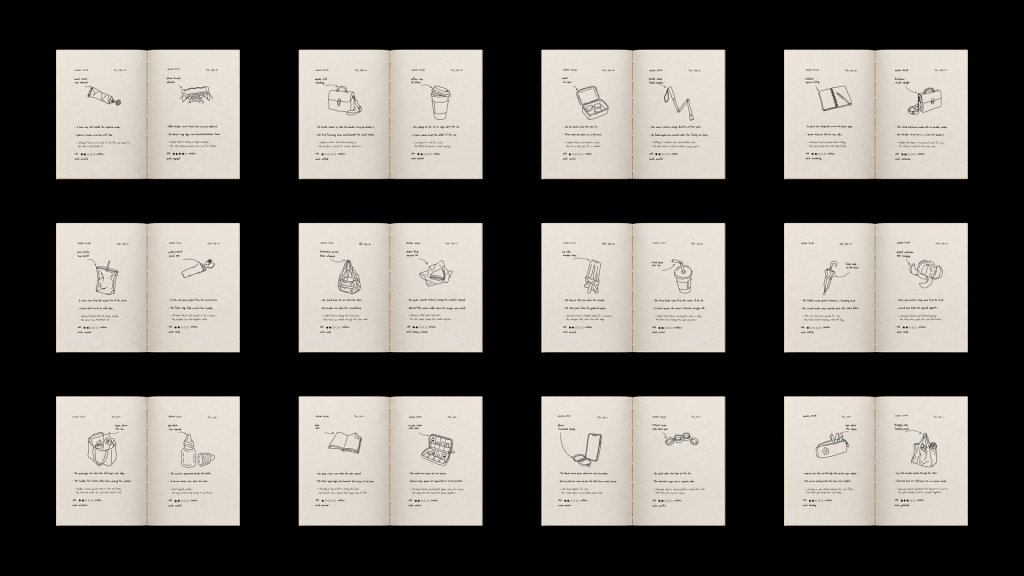
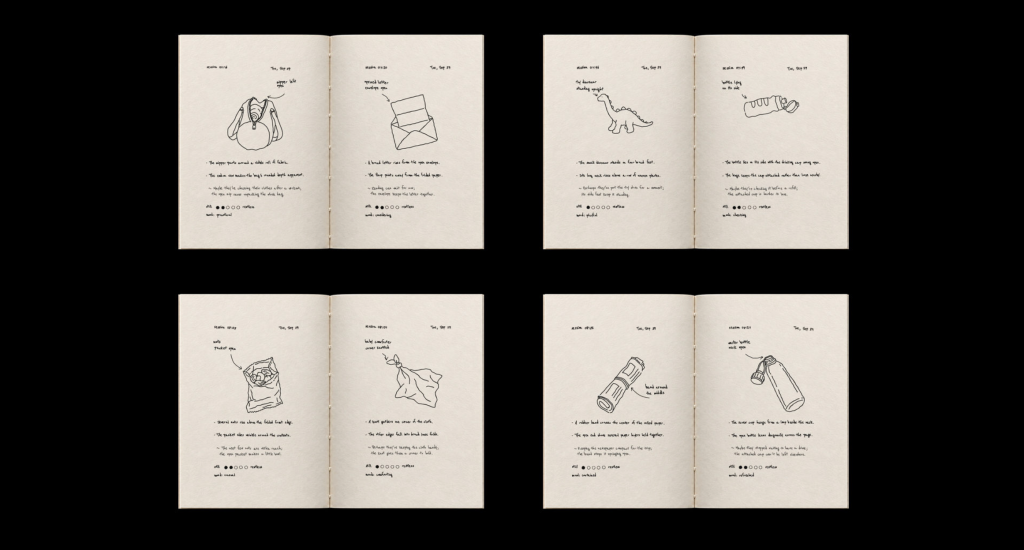
As the number of cards grew, I wanted an overall view rather than isolated observations. I began developing a small book, arranged by time within each day. The sequence could let a reader move through the collection and compare details without assuming that every encounter belonged to one continuous story.
The combined card format: image, description, possible interpretation, mood, and still-to-restless scale.
Week 2: book mockup, four spreads.
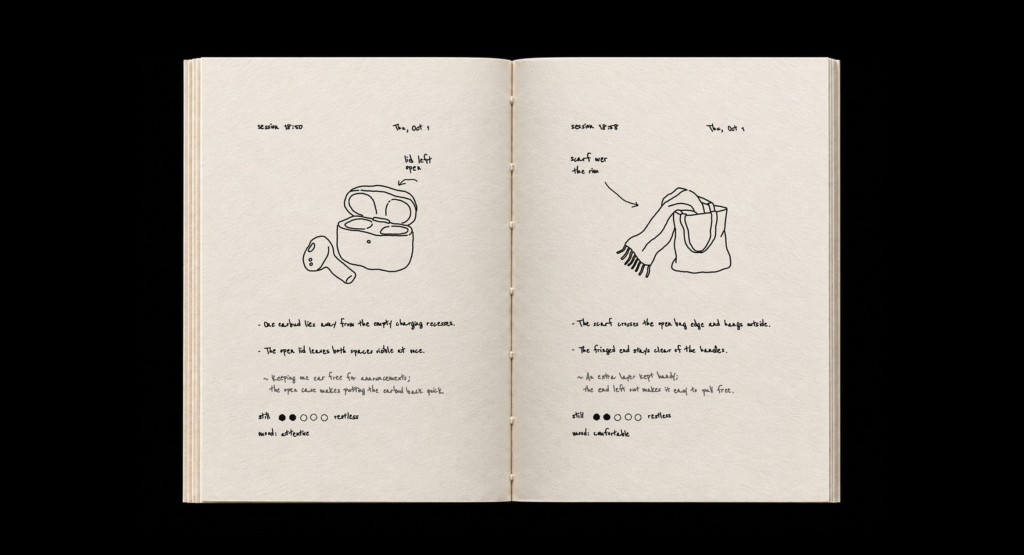
Week 2: book mockup, one spread.
Week 3: the book
For week 3, I expanded the set by 200 cards, bringing the book to 350. I kept the established visual language consistent: black lines, loose lettering, small annotations, and space around each element. Much of the editing involved checking whether drawings and captions agreed, whether arrows pointed clearly without touching the objects, and whether the text had enough room to be read.
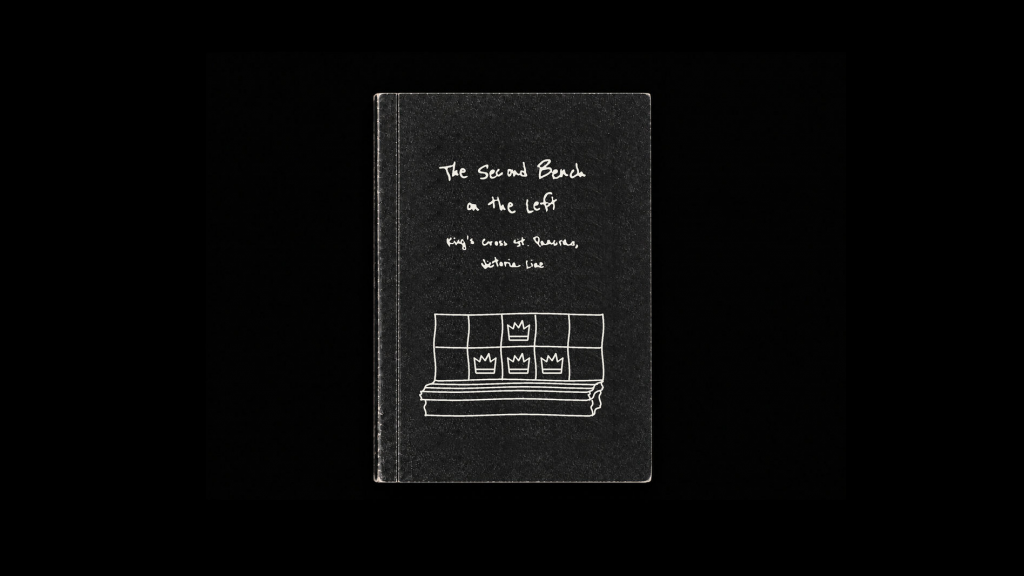
I developed an A6 book file with one card per page. The entire sequence is ordered by its session labels, date, and then time, rather than keeping the first and second sets separate. These labels organize the book; they do not turn reconstructed entries into minute-exact records. The cover carries the project title and the image of the bench. This is a print-ready file, not a book I have physically printed and bound.
The cover used for the A6 book file.
Where the project is now
The project started with noticing what people carry and do while they wait. It has moved toward looking at how I select, interpret, and organize those details. Waiting contains small tasks and interactions that disappear quickly: adjusting a bag, handling a phone, changing shoes, or alerting someone to a dropped card.
I can record an action without knowing the person’s reason for it. That limit is something I want the work to keep visible. The book gives the collection a sequence. My next step is to look back through it and ask what the collection reveals about the site, including what my attention might have missed.