Unit 1 · Methods of iterating
Initial idea: copying Skin on Skin
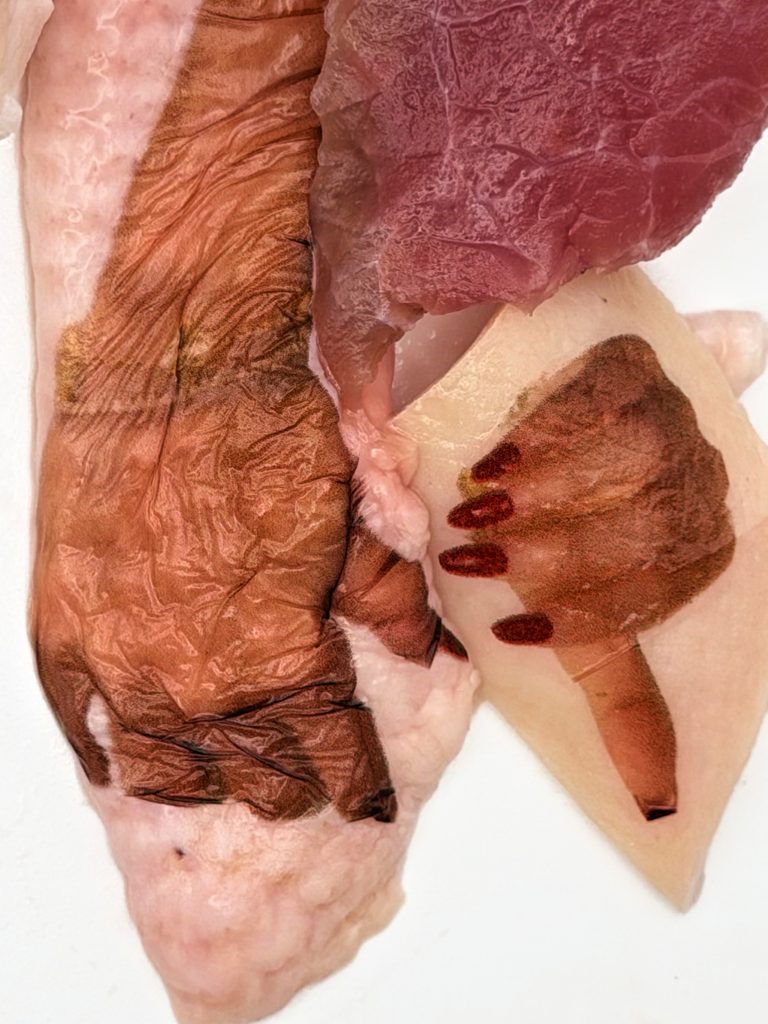
For this brief, I chose to remake John Yuyi’s Skin on Skin (2016). In that project, Yuyi turns nude self-portraits into temporary tattoos and transfers them onto skin-on pork, then photographs the result. A person’s skin becomes an image, and that image is laid onto another skin.
The questions I wanted to pursue came from putting myself in her position. What of the person pictured survives the transfer, and how does the new surface change it? At what point does a body stop being someone’s own and become a set of parts to be judged? A woman’s image on meat can make the body look like a product. I wanted to know whether deciding how my own body appears could give me some control, or whether it would only repeat the ways women’s bodies are already looked at.
Photographing my own body would put me on both sides of those questions, as the person pictured and the person looking. But the first step was the copy itself: remaking Yuyi’s work as closely as I could, in a medium I had never used.
Week 1: making the copy
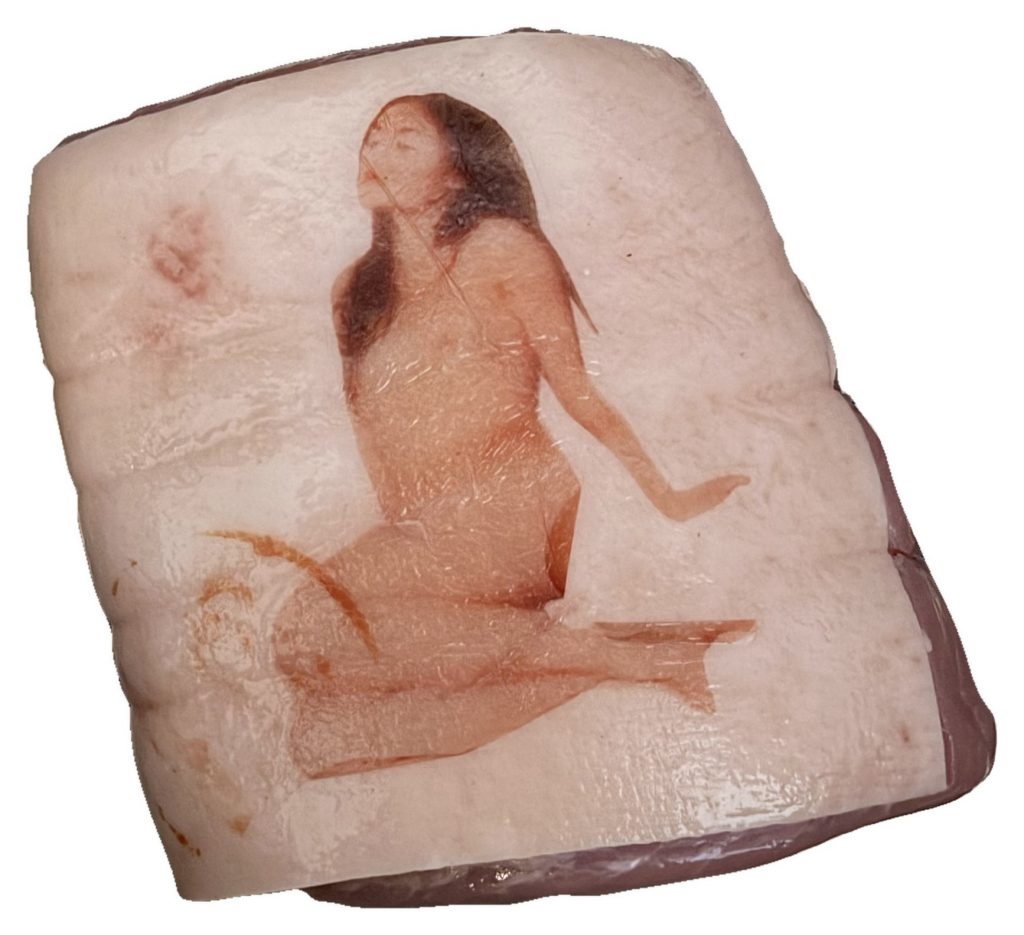
I printed one of Yuyi’s portraits onto temporary tattoo paper with a home inkjet printer, mirrored so the image would read correctly once transferred. My first print came out faded because I had printed on the wrong sheet, and a later attempt trapped air bubbles inside the transfer layers. The transfer that worked went onto pork skin, and I photographed the result against a plain white background, the way Yuyi presents her own photographs.
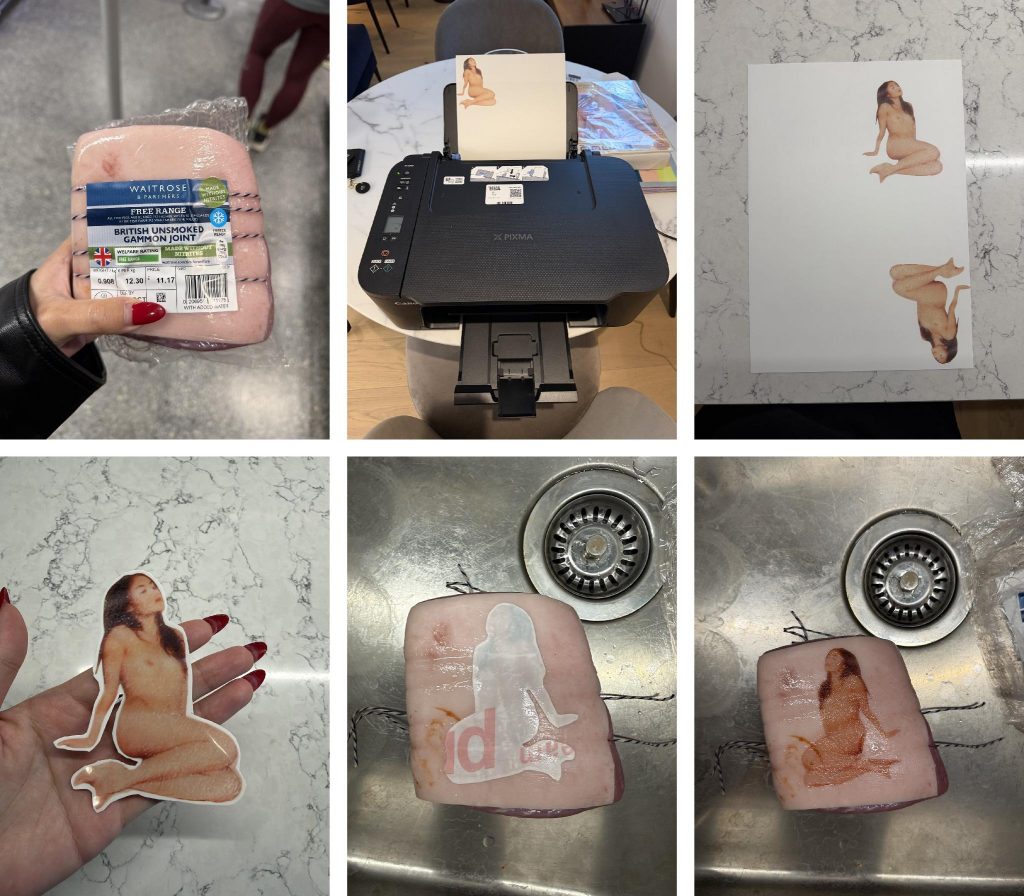
One successful transfer was enough for the copy, but not for the project. The feedback after my first presentation pushed the work further: the method was quick to pick up, and a single transfer did not test it. The next stage had to build process and repetition into the work, many transfers rather than one, while keeping the tattoo method at its center.
Week 2: reconstructing the body
I photographed myself in ten poses selected from Andrew Loomis’s Figure Drawing for All It’s Worth, working from more open arrangements toward poses with more bends, twists, and overlapping parts. I cut each printed photograph into six anatomical sections: the head and neck, the torso, two whole arms, and two whole legs. Each section was transferred onto its own small piece of meat, using different animals across the pieces. I then arranged the pieces to reconstruct each original pose as closely as I could, producing ten outcomes.
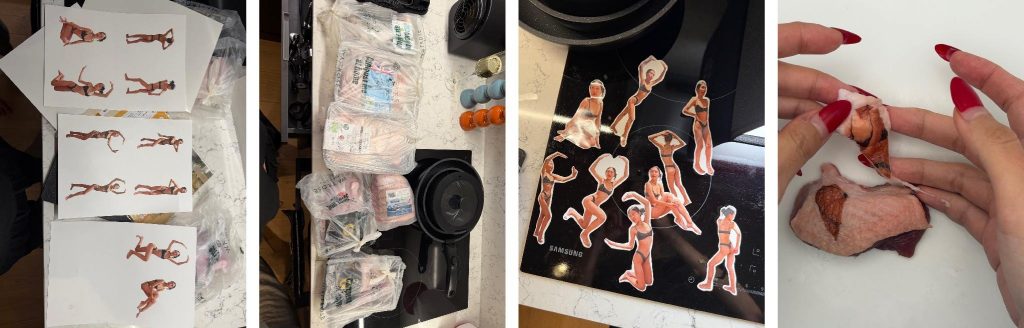
This pushed the question from the copy further: what of the person pictured survives the transfer, and how does the new surface change it? Rather than deliberately distorting my body, I tried to keep it recognizable while the pieces of meat cut it apart. The cuts, gaps, and differences between the pieces could make some parts more prominent or harder to connect. I wanted to know whether the reconstructed image still read as a person, or whether it asked people to look at individual parts instead.
Alongside the making, I was reading Eva Stenram’s Drape, a series where parts of women’s bodies disappear behind digitally extended curtains. It helped me separate two things the reconstructions were doing at once: physically dividing my image, and directing how someone looks at it. The cuts could divide the image; they could not determine how it would be read.
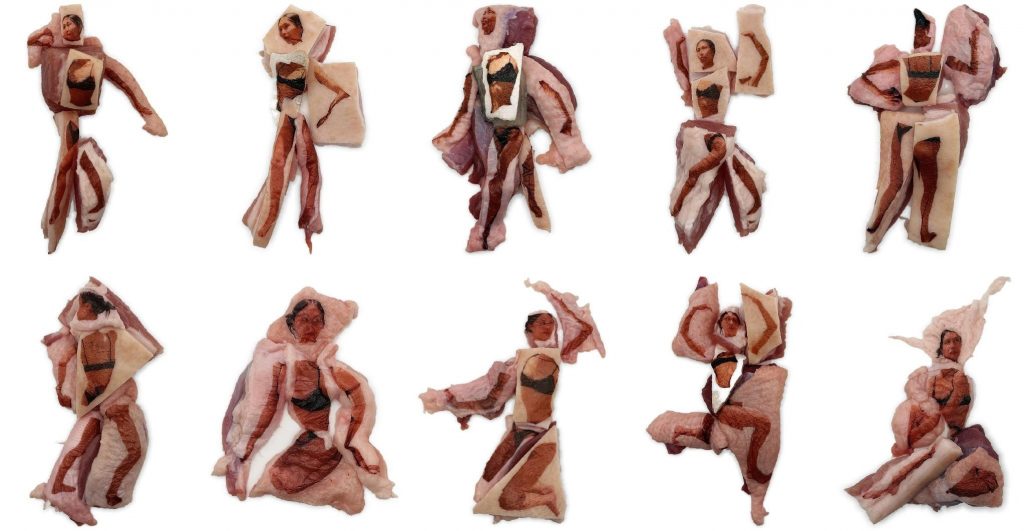
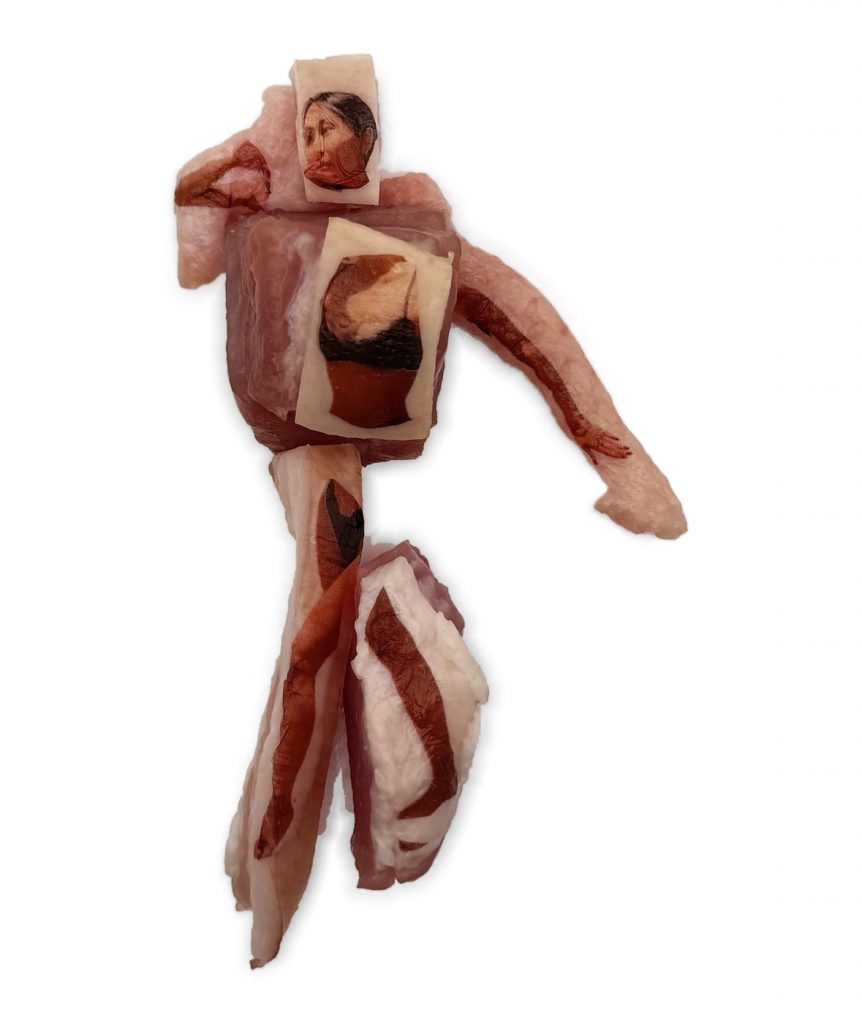
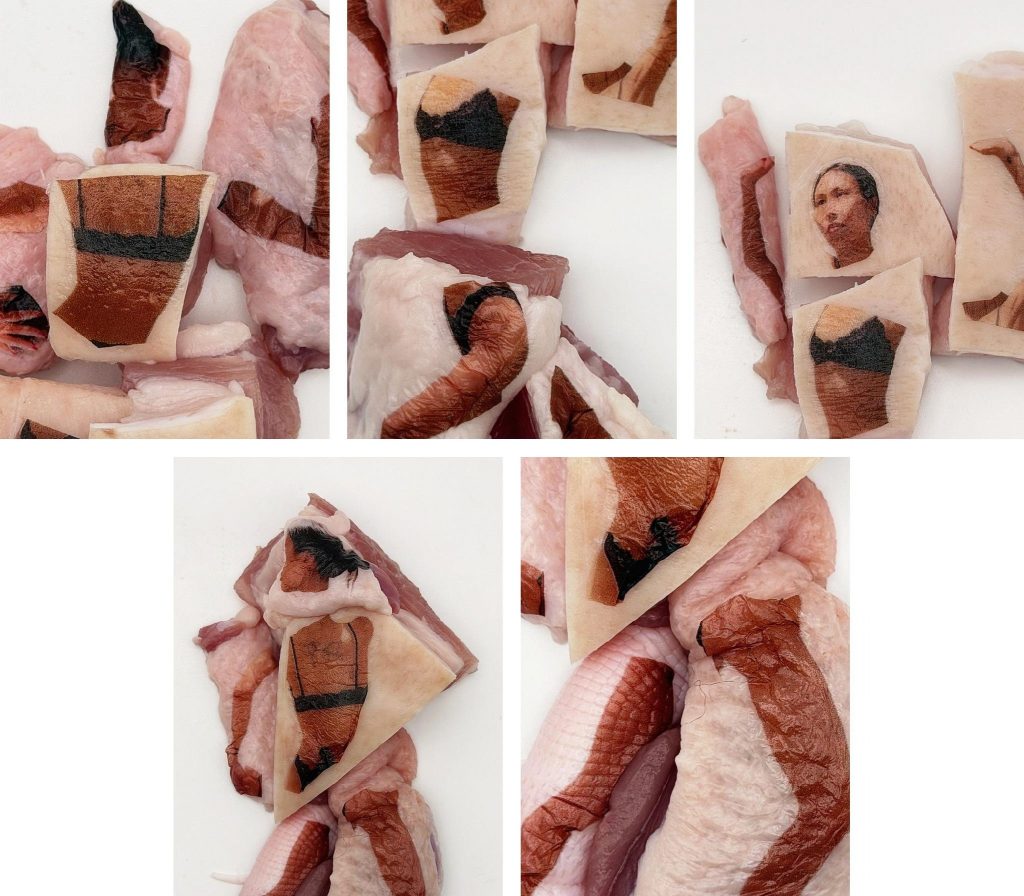
Looking at the ten outcomes, I kept returning to the difference between recognizing parts of myself and recognizing myself as a whole. The transfer preserves familiar details of my face, skin, and clothing, but changes how they appear; the meat’s own colors, fat, and folds stay visible alongside the print. A fragment can remain identifiable without restoring the person it came from, and a readable pose does not necessarily make the figure feel like me. I was left asking whether I was recognizing myself, or connecting the fragments because I already knew they belonged together.
Week 3: rearranging the body
Matching the original pose had given each reconstruction a clear aim, but it left my question open: did I actually recognize myself in the figure, or did I only remember the photographs it was built from? For the final week, I stopped rebuilding the body and started rearranging it.
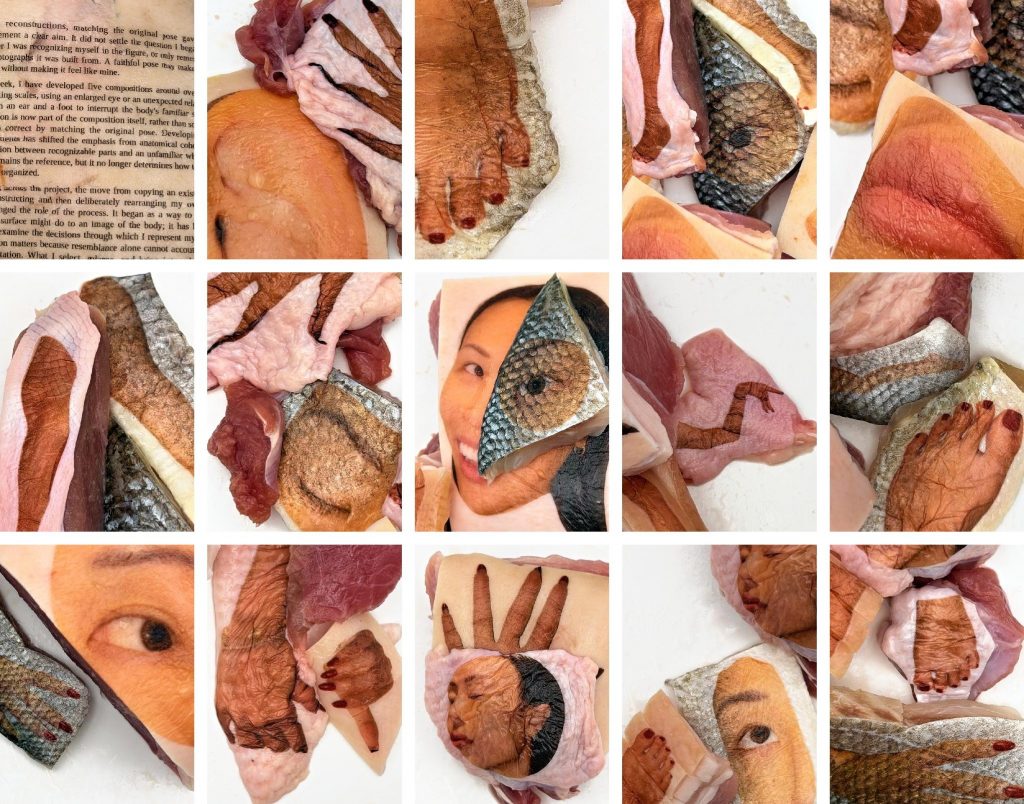
I took new photographs of my own body and made five compositions, each built from four to six pieces, with every photograph transferred onto skin-on meat. Referencing Hannah Höch’s collages, I let the pieces overlap and collide at conflicting scales: an enlarged eye, a foot meeting an ear. Each composition stays recognizable and unfamiliar at once. Distortion became something to compose with, rather than a flaw to fix against the original pose. The body is still the reference, but it no longer dictates how the image has to be arranged.
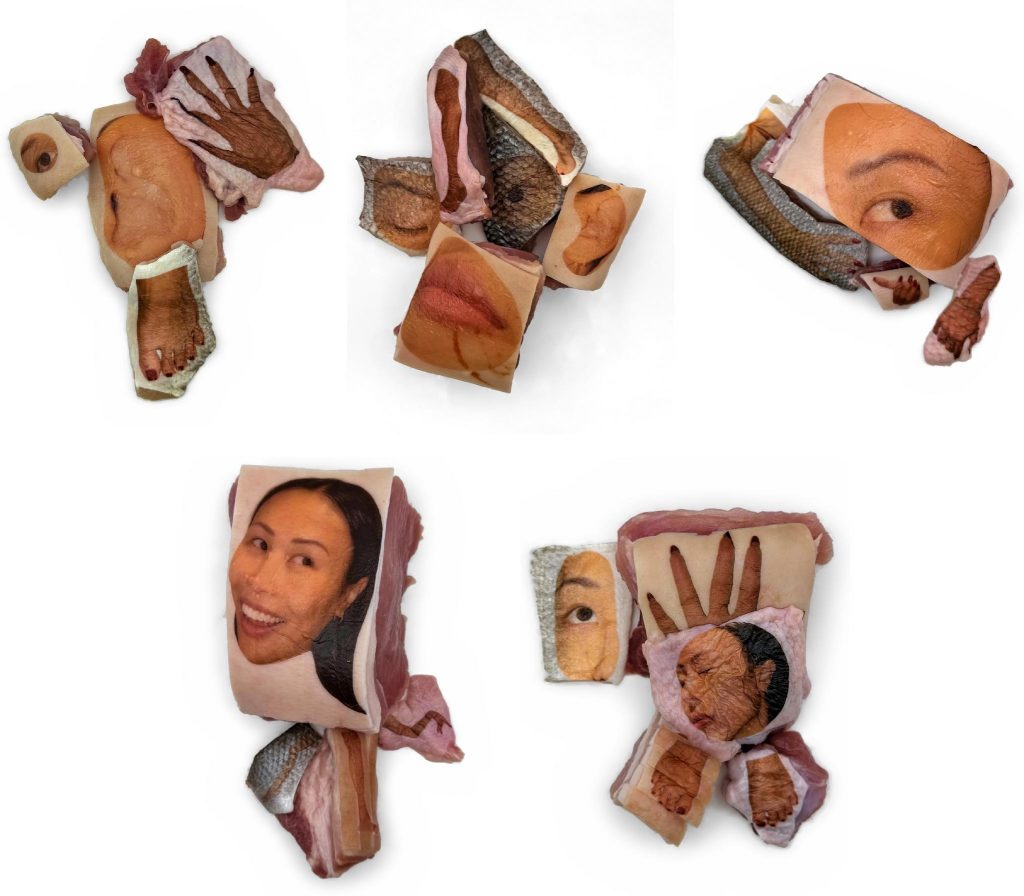
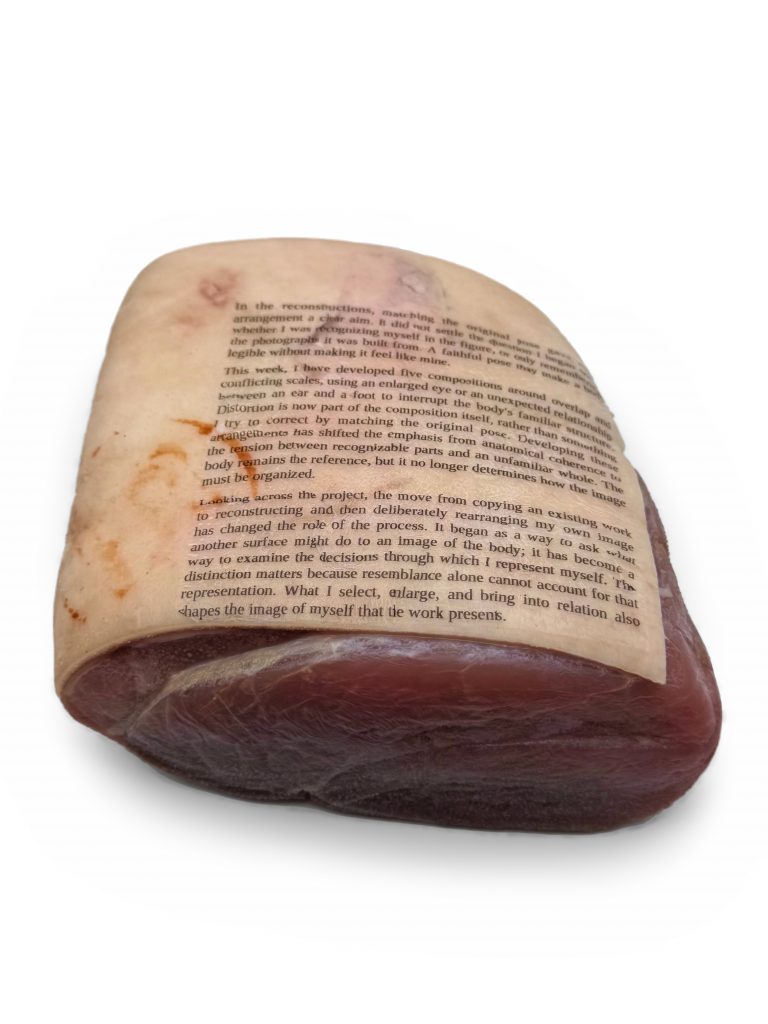
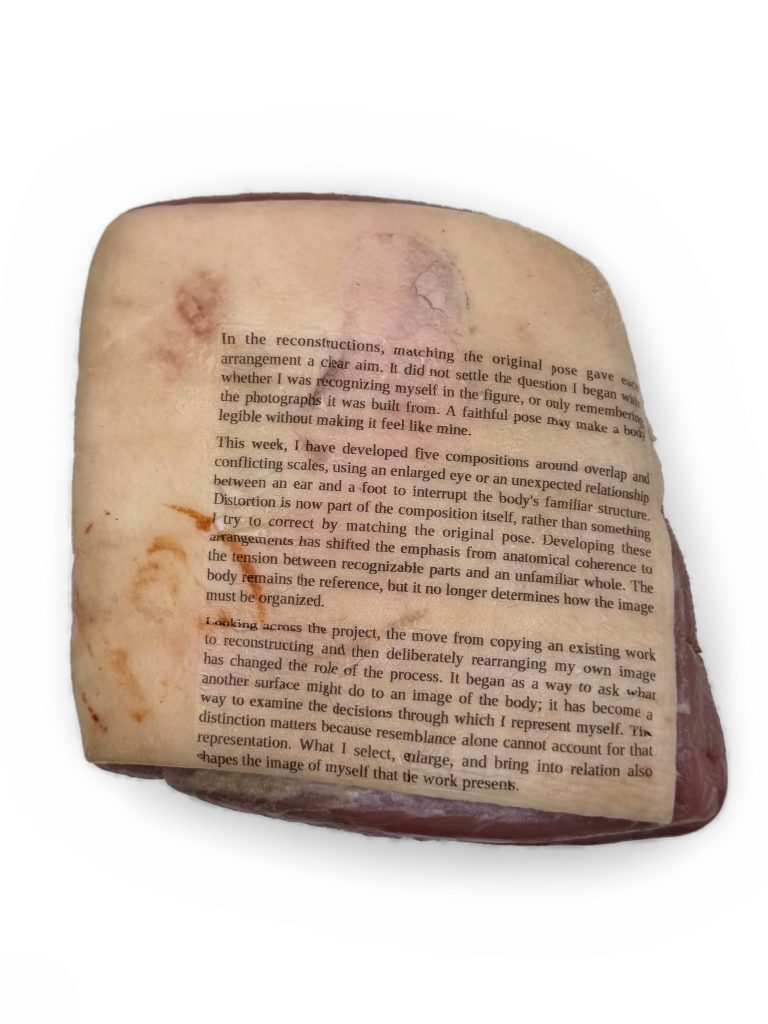
The writing entered the medium as well. The final draft of my written response, covering this last week’s progress and reflecting on the project as a whole, was printed and transferred onto a piece of pork skin.
Where the project is now
Over three weeks, the project moved from copying an existing work, to rebuilding my own image from pieces, to deliberately rearranging it. The project started by asking what a different surface could mean for an image of the body, and it has become a way to look at the decisions I make when I represent myself. A likeness alone is not the whole picture: what I select, enlarge, and place next to each other also shapes the image the work presents of me. The question I am left with is where recognition actually sits: in the photograph, in the surface beneath it, or in the person doing the looking.
Leave a Reply